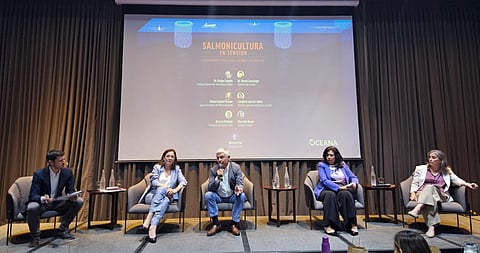


From left to right, panel moderator Nicolás Vial, Chilean Superintendent of the Environment Marie Claude Plumer, SalmonChile President Arturo Clément, Oceana Chile Executive Director Liesbeth van der Meer, and Intesal Director Marcela Bravo.
Photo: SalmonChile.

Organized by Oceana Chile, the seminar 'Salmon farming under pressure: balancing science, regulation, and nature' was the reason for the unprecedented meeting between the ocean conservation and protection NGO and the trade association SalmonChile, which, together with representatives from the scientific, public, and private sectors, gathered in the capital, Santiago, to analyze the current and future challenges facing the country's aquaculture sector in environmental, economic, and social terms.
With a debate focused on the need to strengthen increasingly sustainable and transparent salmon farming based on scientific evidence, during the conference, the various stakeholders addressed fundamental issues such as the use of antibiotics, regulatory frameworks for aquaculture, and its impact on ecosystems.
Thus, one of the highlights of the seminar was the final panel discussion. Moderated by journalist Nicolás Vial, it explored possible ways to strengthen responsible aquaculture with a focus on environmental protection and economic development.
The panel participants were Chilean Superintendent of the Environment Marie Claude Plumer; Director of Intesal (SalmonChile's Salmon Technology Institute) Marcela Bravo; Executive Director of Oceana Chile and Senior Vice President of the global organization Liesbeth van der Meer; and President of SalmonChile Arturo Clément.
Although this is not the first time that the latter two have spoken or participated in an event—as Clément himself recalled during the panel, van der Meer participated in the 2024 Salmon Summit, and they have even worked together with Oceana on a bill—this was the first time that the trade association representing Chile's leading salmon farming companies and suppliers was invited to a seminar organized by Oceana.
"We may have some differences, but we agree on many issues," pointed out the President of SalmonChile during the panel discussion, after expressing his gratitude for the invitation. The following day, the trade association extended that gratitude in a post on LinkedIn.
"This is no small gesture. We are deeply grateful for the invitation and firmly believe that initiatives of this kind should continue," wrote SalmonChile.
"It is good to have opportunities for discussion on such an important issue as the one that brings us together here today," said Marie Claude Plumer, head of the Chilean Superintendency of the Environment (SMA).
As mentioned above, the title of the seminar was 'Salmon farming under pressure: balancing science, regulation, and nature', so the regulatory framework for the sector, with particular emphasis on what comes next—auditing and how to carry it out efficiently and effectively—was one of the key topics discussed during the debate.
"Today, practically 100% of certain items of interest are monitored by the supervisory authority of sites that have an environmental qualification resolution under a model that has been developed based on three pillars: prevention, correction, and penalizing response. This model obviously requires high-quality data and prioritization with the support of technology, which has allowed us to expand this coverage," said Plumer.
For her part, the Executive Director of Oceana Chile, Liesbeth van der Meer, acknowledged that progress is being made, but lamented that it is slow compared to the increase in production, which she said has risen by 50% since 2014, reaching 1,000,000 tons. "Increasing to 1,500,000, imagine what that means for the state, for the environment," she said.
van der Meer acknowledged Intesal's work in supporting the use of technology and innovation in aquaculture and salmon production in Chile, but as mentioned, this is SalmonChile's Salmon Technology Institute, so, a private initiative.
In her opinion, it should be "the state machine" that should be investing heavily in this, in supporting the SMA and Sernapesca—Chile's National Fisheries and Aquaculture Service—to carry out this oversight, and ensure that penalties are proportional to the profits generated by companies when they fail to comply with regulations.
"NGOs are not people who want nothing to be done, who want everything to come to a standstill. We are also looking 100 years, 200 years ahead, which is why we create marine protected areas and work on sustainable fishing, restoring important fisheries such as jack mackerel, for example," said the Executive Director of Oceana Chile.
"And it is that long-term vision that is so important today, which is why dialogue is so important to move forward more quickly," she continued. "You can't question what the supervisory authority is doing because that is its role, and if it has to impose sanctions, it will have to impose sanctions. That is the message we want to convey here as well, that NGOs are necessary for all societies to function equitably," van der Meer added.
The president of SalmonChile, for his part, also emphasized the importance of maintaining ongoing and fluid dialogue. "Participating in these forums is essential to moving toward modern regulation based on science and a shared vision of the future," he said.
"At SalmonChile, as a trade association and productive sector, we are open to dialogue, transparency, and collaborative work, because we believe that this is how the agreements that Chile needs are built," continued Arturo Clément.
"We will continue to push for salmon farming that is even more demanding on itself, capable of responding with action to the challenges facing southern Chile, while at the same time aspiring to clear regulatory frameworks that provide stability and prospects for the sustainable development of the sector," he added.
"If we want the country to be a global benchmark in the blue economy, these types of meetings are an essential part of the journey," the president of the salmon farming trade association concluded.
For her part, Intesal Director Marcela Bravo highlighted the key role of science in decision-making when it comes to moving toward more sustainable aquaculture in Chile.
"Science cannot remain confined to papers and laboratories. We need it to be part of public discourse, to inform decisions, and to help build trust. At Intesal, through collaborative work with multiple institutions, we strive to put evidence first and engage in open dialogue," said the Director of SalmonChile's Salmon Technology Institute.
"That is why we deeply value spaces like this, where all stakeholders sit down at the same table. Because building sustainability is not always about reaching consensus, but rather about being able to move forward on a common basis of rigorous knowledge and shared responsibility, strengthening a model that reconciles environmental protection with economic development," added Bravo.
SalmonChile highlighted that the event—which was broadcast on Oceana Chile's YouTube channel and remains available for public viewing, in Spanish— "represents a significant step forward in building agreements and strengthening dialogue between the different sectors involved in the development of sustainable aquaculture in Chile."
