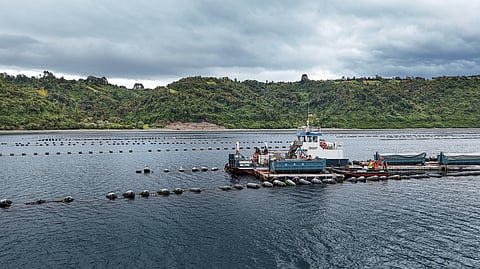


One of the mussel farms whose production will be moved using maritime transport.
Photo: Camanchaca.

Intending to be more efficient in its operations and ensure a continuous supply of raw materials for its processing plant Camanchaca Cultivos Sur, Camanchaca has launched a pilot project for maritime transport logistics for its mussel business.
Developed as a joint venture with local producers and maritime operators, the initiative will allow the transfer of approximately 9,000 tons of raw materials through regulated docks, avoiding the entry of approximately 400 trucks to beaches and hard-to-reach areas.
According to the Chilean seafood company, this not only represents a positive impact on operations, but by decongesting land routes during the peak summer season in Chile, it also minimizes risks and impacts on local communities, reinforcing both road safety and the coexistence of the business with its surrounding environment.
"This maritime logistics pilot program allows us to operate more efficiently, minimizing risks and giving us better access to supplier farms, while also contributing to the safety of coastal communities during a period of high population density, such as summer," said Rafael Ortega, Regional Manager of Camanchaca Cultivos Sur.
The initiative has been praised by the productive sector for its territorial impact. "It is an alternative that reduces risks on beaches and streamlines operations, generating benefits for both producers and communities, thus minimizing the operational impact we have in the locations where we are present," said Víctor Barría, raw materials producer and Director of AmiChile, trade association of small, medium and large producers in the Chilean mussel farming industry.
Currently, five local producers participate in this operation, representing approximately 40% of Camanchaca's total annual raw material purchase volume. Nevertheless, the company emphasized its expectation of expanding this coverage throughout the year. The model also considers the equitable distribution of costs among the parties involved.
As mentioned, this pilot project of Camanchaca for maritime transport logistics has been launched at Camanchaca Cultivos Sur, the company's mussel processing plant in Chonchi, Chiloé province, in the Los Lagos region.
Thus, the company noted that, initially, maritime logistics will be carried out in the Lemuy/Hudson Channel area, facilitating access to cultivation sites that are difficult to access by land, and considering landing in the municipality of Chonchi. The next phase will cover the Dalcahue/Achao area, and in a third stage, the northern part of the island, including Quemchi.
Camanchaca aims to cover almost 90% of the plant's supply through this method. Furthermore, in the medium term, it expects to expand this logistics to other mussel farming sites located in Chiloé, moving towards a safer model aligned with the sustainable development of the territories where it operates.
This part of the business is important for the Chilean seafood company. According to its latest earnings report, corresponding to Q3 2025, through September 2025, Camanchaca's mussel business had increased its revenues by 30% to USD 36.6 million.
