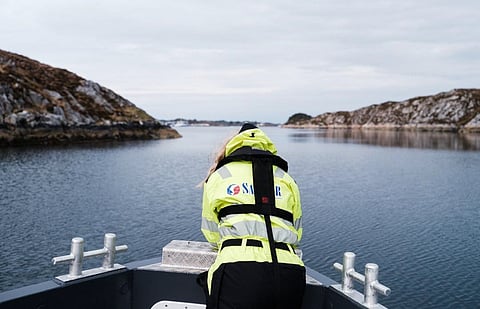


In 2025, SalMar reached a milestone as, for the first time, the Group exceeded 300,000 tons harvested in a single year.
Photo: SalMar.

With lower costs across the value chain and rising market prices, the Q4 2025 results, which not only increased significantly compared to the same quarter of 2024, but also compared to previous quarters of 2025—"weak" was the word repeated in the headlines of the company's earnings reports in Q1, Q2 and Q3—enabled SalMar to recover and close last year on a positive trend.
Moreover, in 2025, the Norwegian salmon producer also reached a significant milestone as, for the first time, the Group's harvest exceeded 300,000 tons in a single year. Specifically, the total harvest, which includes its associated companies, reached 300,900 tons.
Cost reductions across the value chain were the highlight of SalMar's fourth quarter of 2025; however, they weren't the only factor contributing to its positive results. As the company noted, this was further bolstered by rising market prices after a year marked by declines—as reported by the Norwegian Seafood Council, 2025 was characterized by strong volume growth for salmon, which led to a drop in prices.
Thus, with a harvest volume of 84,100 tons in the quarter, an increase of 10.3% year-on-year, in Q4 2025, operational EBIT for SalMar Group was NOK 1,834 million, 345% up compared to the same period last year, and operational EBIT per kg was NOK 21.8, which was an increase of 1.6% compared to Q4 2024.
In its report, the company also highlighted that, although reduced profitability was recorded from the Sales & Industry segment in Norway, the Farming segment had continued good operational and biological performance.
Meanwhile, its subsidiary in Iceland, Icelandic Salmon—Arnarlax's parent company—achieved improved results driven by reduced costs. The same cannot be said for its operation in Scotland, where Scottish Sea Farms, its joint venture with Lerøy Seafood (each owning 50%), obtained weak results, according to the SalMar presentation.
"The fourth quarter marks the end of a year with lower market prices, but underlying demand has been strong, and we have used the year actively to develop both new and existing markets," said SalMar CEO Frode Arntsen. "At the same time, 2025 has been a good operational and biological year for SalMar, which is now reflected in lower cost level across all segments," he added.
Regarding its results for the full year 2025, beyond that record of achieving more than 300,000 tons in a single year, SalMar emphasized the same as its CEO: high supply growth affected market prices and, consequently, the Group's financial results, which, however, have varied from one region to another.
In Farming Norway and SalMar Ocean, the company reported a record-high harvest volume and strong biological performance, especially from Northern Norway, and added that the operational set-up in the value chain continued to showcase strength.
SalMar also highlighted that 2025 was a year in which it strengthened its presence in its key regions in Norway through various mergers and acquisitions (M&A). In February, it completed the purchase of a majority stake in Knutshaugfisk AS, which had been announced in November 2024, and in August, it did the same with Wilsgård AS, whose acquisition had been announced in April 2025.
However, buying wasn't its only move. During the period, the Group sold its 50% ownership in the jointly controlled entity Kirkenes Processing AS, which resulted in a gain of NOK 30 million, and also divested its 24.87% ownership in the associated company Skamik AS, generating a gain of NOK 12 million.
While this was happening in Norway, its subsidiaries in Iceland and Scotland were experiencing different situations. While Icelandic Salmon posted weak results in 2025 due to biological challenges, it also reported an improved biological situation by the end of the year. In contrast, Scottish Sea Farms' results were affected by biological challenges right at the end of 2025.
In its FY 2025 report, SalMar also highlighted that the Group was ranked as one of the world's most sustainable corporations in the 2026 'Global 100 Most Sustainable Companies' list by Corporate Knights. Released, as each year, at the end of January during the World Economic Forum in Davos, SalMar, ranked 67th, taking the top one spot in 'Food and beverage manufacturing'.
As for the year that has just begun, the Norwegian salmon farming company highlighted that, after investing considerably in the value chain over several years to improve biological performance, it expects a lower level of investment in 2026. Specifically, SalMar said it plans to invest NOK 1.1 billion, with the majority of that investment related to maintenance.
In its Q4 and FY 2025 report, the company, which began the year announcing a new M&A move—the acquisition of 49% of the shares in the salmon farming company Øylaks MTB AS, of which it already owned 51%—, also reported that it is initiating a strategic view of ownership in the associated company Hellesund Fisket AS.
About its future performance, SalMar believes it has a solid foundation since, as highlighted in its statement on the results, it is experiencing strong demand for its products while, after high supply growth in 2025, it expects low global supply growth in 2026. All this, while the company has record biomass at sea with lower costs and, at the beginning of Q1 2026, harvested salmon with the highest proportion of premium quality in 10 years.
Thus, for 2026, the salmon farming company maintains its volume guidance of 296,000 tons in Norway, Ocean, and Iceland, and reduces Scottish Sea Farms by 2,000 tons to 43,000 tons (100% basis). Adjusted for SalMar's relative share in the Scottish company, the total expected volume for the Group is 318,000 tons. Compared to 2025, this would represent a 6% increase in harvested volume.
"SalMar turns 35 in 2026, and we enter the anniversary year with record‑high biomass, a lower cost level, and the highest share of superior quality fish we have seen in ten years. This puts us in a strong position to meet market demand with healthy and nutritious salmon, and provides a solid foundation for strong performance throughout 2026," CEO Frode Arntsen summarized.
