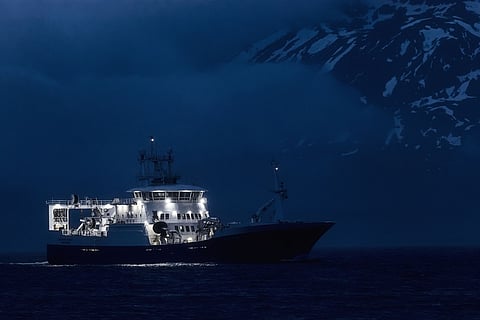


The total capelin quota for Iceland in the 2025/2026 fishing year is 150,860 tons.
Photo: Adobe Stock.

After two difficult years for this fishery, Iceland's Ministry of Industry and Trade announced that the Icelandic Marine Research Institute's proposal for capelin catches in the 2025/2026 fishing year in the country has been increased to almost 200,000 tons. Specifically, the quota advice is up to 197,474 tons.
"These are truly welcome news, as capelin seasons over the past two years have, to say the least, been poor. The advice was zero in 2024, and last year it was just over 8,000 tonnes. We estimate that this season will now generate export values exceeding ISK 20 billion," said Hanna Katrín Friðriksson, Iceland's Minister of Industry.
This quota increase is based on the results of capelin surveys conducted by the Icelandic Marine Research Institute (Hafrannsóknastofnun), which, with the participation of five vessels, were carried out from January 19 to 25 this year and covered a large area to the northwest, north, northeast, and east of the country.
According to the results, capelin was distributed throughout much of the area, with the highest density in the front of the migration to the east of Iceland and off Húnaflói bay to the north of the country. In total, the fishable stock was estimated at 710,000 tons.
Approximately 54% of this fishable stock (382,000 tons) was located in the east of the country and is expected to continue the traditional spawning migration to the south and west around Iceland. Meanwhile, around 45% (328,000 tons) was measured in the northwest.
The Icelandic Marine Research Institute also said that it is unclear whether capelin in the northwest of the country will migrate beyond Horn and spawn to the west, spawn to the north, or follow the traditional route to the east of the country, so the Institute will investigate this through a campaign in February.
Therefore, while uncertainty remains regarding capelin migration off northwest Iceland for spawning, the Institute recommends that fishing also be conducted off northern Iceland and not solely on the component of the population that has already arrived in the east of the country.
Distribution of capelin in Iceland according to acoustic backscatter values from 19–25 January 2026.
Image: Icelandic Marine Research Institute (Hafrannsóknastofnun).
Iceland's Ministry of Industry also explained that, when making the quota recommendation, in addition to the aforementioned winter study by the Icelandic Marine Research Institute, the current catch control rule of coastal states, which is based on the results of the autumn 2025 studies, was also taken into account.
Thus, in accordance with the agreement between the coastal states, the total allowable catch is divided between Iceland, which receives 81%, Greenland, which receives 18%, and Norway, which receives 1%. In addition, under a bilateral agreement between Iceland and the Faroe Islands, the latter's share is 5% of the total allowable catch of capelin, deducted from Iceland's quota.
Consequently, taking into account the agreement between the coastal states, the distribution between Iceland and Greenland of Norway's quota, the regularization of last year's overfishing, and the fact that both Greenland and the Faroe Islands have authorizations to fish for capelin within Iceland's economic zone, the final total quota for the latter is 150,860 tons, which represents an increase of 118,000 tons compared to the previous recommendation by the Icelandic Marine Research Institute.
"These are, therefore, certainly good news for the national economy, but no less so for the municipalities where capelin is processed," claimed Minister Friðriksson, who is also the head of the Icelandic Department of Food, Agriculture, and Fisheries, which is now part of the Ministry of Industry's portfolio.
In her statements, Hanna Katrín Friðriksson went, nevertheless, beyond purely economic considerations. "One should also not forget how important this is for the entire ecosystem, as capelin is a key part of the diet of other major commercial stocks such as cod and other demersal species," she said.
"It is also worth mentioning that the results of the Marine Research Institute's capelin survey last autumn indicate a good season next year," Iceland's Minister of Industry added.
