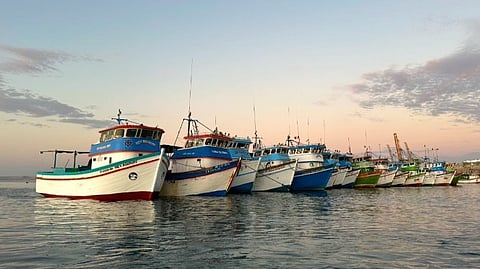


"We want to channel the fishing sector, focusing on continuous improvement and benefits for all fishing families," said Vice Minister Barrientos.
Photo: Produce.

"We have to fish with an eye to the future." Peru's Vice Minister of Fisheries and Aquaculture, Jesús Barrientos, took advantage of a working meeting with union leaders, fishing vessel owners, and representatives of the Social Organizations of Artisanal Fishermen (OSPAS) held in the district of San Andrés, province of Pisco, Department of Ica, to emphasize the need for responsible and sustainable fishing.
The comment was made specifically in relation to the management of bonito (Sarda chiliensis chiliensis), which Barrientos said is an important resource for ensuring the future of the sector and the families that depend on this activity.
Beyond the management of the bonito fishery, one of the main topics addressed during the meeting with fishermen was the amendment of the National Fishing Policy to allow for the classification of the artisanal fleet using technical criteria, as well as occupational health and safety for crew members.
"We want to work with Congress to refine this regulation," said Barrientos. "The goal is to have a clear, technical framework that is developed with the participation of the fishermen themselves," he added. In this context, the Vice Minister urged fishermen to actively participate in this process.
Peru approved its first-ever fisheries policy last August, just days after former President Dina Boluarte identified fishing and aquaculture as two key sectors for Peru's economic growth during her speech to the nation on the occasion of its National Holidays.
The purpose of the new policy, as then explained by the Peruvian Ministry of Production (Produce), is to transform the country's fisheries sector through management, technological innovation, and improved marketing of value-added hydrobiological products.
"Peru is a fishing country, recognized by FAO as one of the most productive seas in the world. However, we did not have a National Fishing Policy; therefore, its approval was one of President Dina Boluarte's commitments," said at the time who then was the head of Produce, Sergio González Guerrero.
Shortly thereafter, the Peruvian Congress removed Boluarte as President and replaced her with José Jerí, who, a few days later, presented his new Council of Ministers, which included a new Minister of Production, responsible for the Department of Fisheries and Aquaculture, César Manuel Quispe Luján, who has held the position ever since.
At the time of his designation, Quispe Luján reaffirmed his commitment to promoting innovation, competitiveness, and sustainable development in the productive sectors, consolidating Produce's role as an engine of economic growth and national productive transformation in Peru.
This roundtable discussion is part of the government's direct engagement with the artisanal fishing sector, which began under the previous administration following the end of the jumbo flying squid crisis, and is also part of a working agenda based on dialogue with the country's main productive actors, initiated by the new Minister of Production.
On it, another point discussed was the importance of fishing vessels having the government-supported Satellite Tracking System (SISESAT). SISESAT is a technological tool that allows Peruvian authorities to track the location, course, and speed of fishing vessels in real time.
The system is key to ensuring compliance with fishing regulations, protecting hydrobiological resources, and preventing illegal, unreported, and unregulated fishing (IUU fishing). It also facilitates evidence-based decision-making and reinforces transparency in extractive activities.
During the working meeting held by the Peruvian Vice Minister of Fisheries and Aquaculture in San Andrés, Pisco, the benefits that this tool represents for fishermen were discussed, both in terms of management and safety. Its role in tracking the position of vessels and strengthening sustainable and responsible fishing was also reaffirmed.
"We want to channel the fishing sector, focusing on continuous improvement and benefits for all fishing families. The challenge is to learn to coexist between vessels of different storage capacities, under clear rules," concluded Barrientos, reaffirming the government's willingness to continue strengthening the fishing sector.
