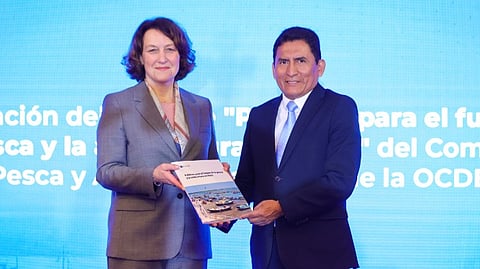


Marion Jansen, Director of Trade and Agriculture Directorate at the OECD, and César Manuel Quispe Luján, Peruvian Ministry of Production, presented the report 'Policies for the Future of Fisheries and Aquaculture in Peru'.
Photo: Produce.

At an event held yesterday in the country's capital, Lima, Peru's Ministry of Production (Produce) presented the assessment report on the fisheries and aquaculture sector prepared by the Committee on Fisheries (COFI) of the Organisation for Economic Co-operation and Development (OECD), describing it as "a decisive step" toward the country's integration into the organization.
According to Produce, the recently declassified document shows that Peru compares favorably with OECD best practices in fisheries and aquaculture policy, and that the organization describes the South American country's fisheries management—based on scientific research and analysis—as "world-class."
The event, which was attended by various Peruvian authorities, including the Minister of Production, César Manuel Quispe Luján, and Vice Minister of Fisheries and Aquaculture, Jesús Barrientos, also included the participation of prominent OECD authorities, such as Marion Jansen, Director of Trade and Agriculture Directorate, and Claire Delpeuch, Head of Unit, Fisheries & Aquaculture.
The two leaders of the Organisation for Economic Co-operation and Development will present the conclusions of an audit initiated in 2023, which included rigorous on-the-ground research missions in Peru.
The report, titled 'Policies for the Future of Fisheries and Aquaculture in Peru', provides an independent analysis of how the country manages its hydrobiological resources. According to Produce, one of its key findings is that the vast majority of the assessed fish stocks remain at biologically sustainable levels, with particular emphasis placed on the adaptive management model for anchovy.
The Ministry of Production continued to emphasize that the report underscores the robustness of the Peruvian model, in which catch quotas and closed seasons are not political decisions, but rather the result of rigorous scientific monitoring conducted by the Peruvian Sea Institute (Imarpe).
As noted in the report's abstract published on the OECD website, Peru ranks among the world's largest fish producers with 5.5 million tons in 2022, which is equivalent to 3% of global fisheries and aquaculture production. Most of the production—97%—comes from marine capture fisheries, which rely heavily on the Peruvian anchovy (accounting for 77% of marine capture production), and also account for a significant portion of the global supply of fishmeal and fish oil, placing the country at the center of international seafood value chains.
This technical report confirms that the management of anchovies and other key species complies with OECD fisheries management practices, ensuring that the use of Peru's marine biodiversity is compatible with the preservation of ecosystems for future generations.
During the presentation of the report yesterday in Lima, the Director of the OECD's Trade and Agriculture Directorate specifically highlighted that Peru's fisheries management is backed by scientific research. "I would like to highlight one of the clear conclusions, that the Peruvian fisheries sector is distinguished by its sophisticated resource management and planning system, based on world-class scientific research and analysis," said Marion Jansen.
In addition, members of the OECD's COFI recognized the commitment of Peruvian institutions to a sustainable approach to marine resources and emphasized the importance they attach to Peru's participation in relevant regional and global agreements and institutions that underpin social governance.
This international technical validation confirming that its fisheries and aquaculture management system complies with OECD best practices in terms of both sustainability and productivity led the Peruvian Ministry of Production to emphasize that the submission of the report represents a strategic milestone in the country's accession process to the OECD.
As the Ministry also noted, this COFI evaluation process began in September 2023 when it submitted the 'Data and Policy Questionnaires on Peru's Fisheries and Aquaculture' to the Technical Secretariat of the OECD Committee on Fisheries.
In its statement, Produce claimed that this process strengthens the country’s institutional framework, facilitates access to best practices in international cooperation, and ensures a development model that guarantees economic competitiveness and food security.
"By gaining this external and independent perspective, Peru not only strengthens its reputation as a global leader in the management of hydrobiological resources but also establishes a clear roadmap for modernizing its public policies," the release read.
The Peruvian Minister of Production, César Manuel Quispe Luján, who, after the last change of government in the country, was recently ratified in his position by Peru's new President, José María Balcázar, spoke in the same vein.
"This report reflects international recognition of Peru's fisheries management and highlights the country's progress in governance, transparency, and oversight of fishing activities, as well as our ability to manage large-scale fisheries in accordance with sustainability criteria," concluded Quispe Luján.
