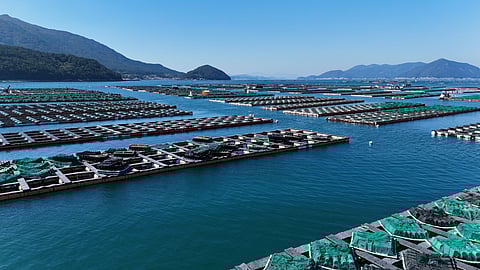


Aquaculture Fields of Tongyeong, South Korea. The sector has been affected by the ageing of the workforce and the low inflow of young workers.
Photo: Adobe Stock.

Acknowledging that its aquaculture industry has suffered from labor shortages due to an ageing workforce and low inflow of younger workers, South Korea announced that, starting this year, it will expand the scope of domestic employment for foreign aquaculture technicians.
In a joint statement from the Ministries of Oceans and Fisheries and Justice, South Korea said that, in particular, the country's aquaculture industry has faced difficulties in securing technicians with the skills required for broodstock management, seed production, smolt production, and grow-out farming.
In response, both ministries have held ongoing consultations, reflecting the sector's demands to expand the national recruitment of foreign aquaculture technicians. As a result, it was decided to carry out a two-year pilot project for a total of sixteen aquaculture species and then expand its application based on the results.
These sixteen species, which are added to the current sea cucumber production pilot project, include the farming of fish, shellfish, crustaceans, seaweed, and invertebrates.
Specifically, the aquaculture products eligible for this pilot program are olive flounder, Korean rockfish, mullet, and red seabream, among fish; oyster, mussel, Manila clam, ark clam, and abalone, among shellfish; white leg shrimp, among crustaceans; seaweed, brown algae, and kelp among algae; and sea squirt, sea pineapple, and omandungi sea squirt among invertebrates, which, as mentioned, are added to the current sea cucumber project in this category.
Thus, on September 23 last year, the South Korean Ministry of Justice decided to issue 'General Skilled Worker (E-7-3)' visas for foreign aquaculture technicians specialized in those sixteen aquaculture species.
Following inter-ministerial consultations on visa issuance requirements, the policy took effect last Friday, January 2, 2026, and, as a result, during the two-year pilot period (January 2026 to December 2027), approximately 200 foreign aquaculture technicians per year (up to two per company) will be able to work in Korea.
"Through this expansion of domestic employment of foreign aquaculture technicians, we have been able to somewhat alleviate the chronic labor shortage in the aquaculture industry and secure specialized personnel in a timely manner," stated South Korea's Acting Minister of Oceans and Fisheries, Kim Seong-beom.
"Going forward, we will continue to monitor the pilot project through surveys and other means, while maintaining close communication with the industry to support the stable operation of Korea's aquaculture industry," he added.
As mentioned above, if the pilot program works as expected, the South Korean government intends to expand its application. This was emphasized by South Korean Minister of Justice Jung Sung-ho.
"The Ministry of Justice will continue to actively utilize the 'Visa and Stay Policy Council' to pursue ongoing improvements to the visa system that reflect voices from the field," he said.
Beyond its borders, South Korea also supports the industry by funding training programs and infrastructure to improve aquaculture production and strengthen the value chain.
One example of this is the collaboration agreement signed last year by the Department of Agriculture (DA) of the Philippines and the Korea International Cooperation Agency (KOICA) to implement projects aimed at improving the working conditions of Filipino fishermen and aquaculture producers.
