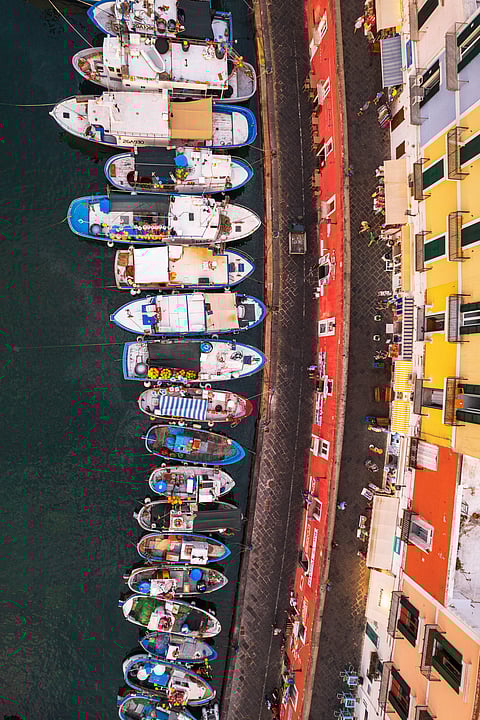


Fishing boats moored in Ponza, Italy.
© General Fisheries Commission for the Mediterranean / Paolo Graziosi.

A new analysis from the FAO’s General Fisheries Commission for the Mediterranean (GFCM) indicates that the share of overfished stocks in the Mediterranean and the Black Sea has dropped to its lowest level in ten years, although overall sustainability continues to remain a concern.
The 2025 State of Mediterranean and Black Sea Fisheries (SoMFi) report was released on 28 November, drawing on contributions from more than 700 experts, and is described as the most ambitious to date, "a result of an unprecedented collaborative effort across the region."
The biennial report assesses assesses 120 stocks across the region and, for the first time, also includes a detailed overview of the "fast-expanding" aquaculture sector.
According to the findings, fishing pressure has been reduced by 50% over the past decade, and the biomass of assessed commercial species has grown by 25% between 2013 and 2023.
The GFCM states that these trends reflect a consistent move toward evidence-based fisheries management policies, noting they follow ten years of "accelerated action" by GFCM's 23 member countries and the EU, "who since 2013 have adopted 11 management plans, established 11 fisheries restricted areas, and launched 18 research programmes and pilot studies to inform decision-making".
“Stocks are not yet where we would like them to be, but they are beginning to recover thanks to science-driven management action and strong stakeholder engagement, while aquaculture, if done responsibly, is proving it can help meet future demand for aquatic foods,” said Manuel Barange, Assistant Director-General and Director of Fisheries and Aquaculture at FAO.
“Maintaining these efforts will be crucial to conserve ecosystems, strengthen livelihoods and ensure the region’s food security through what we call a Blue Transformation,” he added.
Several key species show notable progress, with stocks subject to targeted management plans appearing to recover more rapidly.
Common sole in the Adriatic has seen a 42% fall in fishing mortality and a 64% rise in biomass since 2019, while turbot in the Black Sea has experienced an 86% decrease in fishing mortality and a 310% increase in biomass since 2013. Red mullet and giant red shrimp have also recorded clear reductions in fishing mortality, the report states.
Not all species have responded in the same way, however. Sardine stocks remain under prolonged fishing pressure with signs of biomass depletion. Meanwhile, the highly-valuable European hake shows high variability across subregions, though fishing mortality has decreased by 38% since 2015 and modest biomass improvements have been recorded.
Despite progress, 52% of assessed stocks remain overfished. A decade earlier the figure was 87%. However, the GFCM warns, this is "still too high for a healthy marine ecosystem."
The European Commission’s Milena Mihaylova stated that the improvements “reflect countries’ strong commitment to sustainability,” although she warned that “we cannot assume the work is done”.
The GFCM also highlights additional challenges faced by the Mediterranean and Black Sea fishing sector, including how best to improve compliance with fisheries management measures, and issues related to bycatch and discards of vulnerable species. The livelihoods and future of the workforce is another area of concern, with an ageing workforce and inequalities in profitability posing further challenges.
Aquaculture activities in Tunisia.
Photo: Claudia Amico / GFCM
Alongside fisheries management, the report highlights the rapid expansion of Mediterranean and Black Sea aquaculture.
The SoMFi report finds that marine and brackish aquaculture now represents more than 45% of aquatic food production in the region, reaching 940 000 tonnes in 2023. When freshwater output is included, aquaculture produces nearly 3 million tonnes of aquatic foods and generates $9.3 billion in value. Species such as gilthead seabream and European seabass dominate production, while Türkiye, Egypt and Greece account for the majority of farmed output.
According to Ahmet Seremed, Chairman of the Board of the Central Union of Aquaculture Producers in Türkiye, coordinated action is needed to ensure that aquaculture remains “sustainable, productive, competitive and profitable”.
"At the same time, it should preserve ecological services, ensure animal welfare and contribute to inclusive socioeconomic development in coastal communities,” he added.
The report warns that the sector still faces significant challenges, including environmental impacts, animal health and biosecurity requirements, in addition to complex regulatory frameworks.
Looking ahead, the GFCM estimates that aquatic food production will need to rise by 14–29% by 2050 to keep pace with demand driven by population growth and shifting consumption patterns.
“Aquatic foods, fishers and fish farmers have always played a key role in the region’s coastal communities,” said Miguel Bernal, Executive Secretary of the GFCM. “We need to make sure they continue to do so in the future, through cooperation and effective management.”
