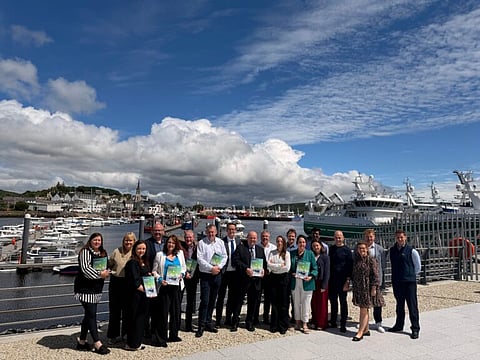


Officials from Ireland's seafood development agency Bord Iascaigh Mhara (BIM) and Donegal County Council launch the report.
Photo: BIM

Ireland’s fisheries and seafood processing sector could use the blue bioeconomy to diversify into higher-value products and build resilience as fishing quotas fall, according to a new report commissioned by Bord Iascaigh Mhara (BIM) and Donegal County Council.
The Scoping Study on the Potential of the Blue Bioeconomy in the Northwest examines how marine biomass, including fishery by-products and underutilised resources, could be used to create new revenue streams for seafood businesses.
Although focused on Northwest Ireland, the report says the findings have wider relevance for a seafood sector facing reduced access to raw material. It was commissioned against a backdrop of successive annual quota reductions, with further cuts for 2026 increasing pressure on fishing and processing businesses.
The report says the 2026 reductions include a 70% cut in mackerel volumes, a 41% cut in blue whiting and a 22% cut in boarfish, arguing these reductions have intensified the need to identify new markets and business models, including opportunities in the bioeconomy.
Speaking at the report's launch, BIM Innovation Manager Michael Gallagher said the sector needed to generate greater value from existing raw material.
“Given the challenges the sector has faced with quota reductions, biomass shortages, and rising supply chain costs, it is crucial that we generate more value from every fish,” he said.
The report says many fisheries businesses already have routes for dealing with waste and sidestreams, but these often involve relatively low-value outlets. These include fishmeal and oil production, pet food ingredients, bait or composting, with the main focus often on avoiding disposal costs and regulatory complexity rather than creating higher-value products.
However, the study found that a number of businesses have already explored ways to extract more value from marine resources, often with support from BIM and research organisations. These include work on hydrolysates from by-products and underutilised species, nutrients from wastewater, creatine from blood water, fertiliser from blue whiting and ingredients from salmon viscera or crab processing sidestreams.
The report says the blue bioeconomy market is expected to grow as demand increases for sustainable, natural and low-waste products. It identifies opportunities in areas including fish protein hydrolysates, marine peptides, collagen, gelatin, chitin, chitosan, biostimulants, nutraceuticals, functional foods, cosmetics and animal feed.
It also highlights international examples from countries including Iceland, Norway and France, where marine by-products have been used to create higher-value products, including the Iceland Ocean Cluster’s “100% fish” approach, which promotes fuller use of each landed fish.
Gallagher said Ireland had both the research capacity and industry base to develop similar opportunities, but that support needed to be better aligned.
“Ireland possesses a wide diversity of high-calibre marine researchers, and progress is already being driven by industry leaders in both the North West and South West. Active engagement with regional networks is generating high-potential opportunities," he said.
"If we can harness these resources at a national level and align supports across relevant state agencies, we can create a clear and coherent pathway for the seafood sector to diversify and unlock greater value from the blue bioeconomy,” Gallagher argued.
However, despite this potential, the report suggests Ireland's seafood sector remains at an early stage in its engagement with the blue bioeconomy. While many businesses have explored extraction processes, it found that knowledge of potential markets, value chains and regulatory requirements remains limited.
It also said businesses are often reluctant to invest in new plant, equipment and expertise without clearer evidence of commercial demand and more certainty over feedstock supply. Some companies consulted for the study said they were in “survival mode” following quota reductions and were cautious about investing in areas still dependent on access to marine raw material.
The study thus recommends a "staged" approach to developing the sector, including best-practice visits, market discovery and validation, stronger links between businesses and research organisations, proactive support for companies, and the development of clustering and collaboration in the Northwest.
It also recommends establishing a steering group with industry representation and developing a structured "pathway of support" for companies interested in blue bioeconomy opportunities.
One possibility considered by the report is the development of shared infrastructure in the important seafood port of Killybegs, including workspace, laboratory facilities and bioprocessing capacity. However, the report suggested establishing a bioprocessing facility there immediately would be "premature", given that most industry players are not yet far enough advanced in exploring blue bioeconomy opportunities.
Instead, the study argues, any future facility should be informed by validated market opportunities, the availability of feedstocks, industry demand and the role of existing or emerging biorefining capacity elsewhere in Ireland.
In the meantime, BIM said it is working with Donegal County Council and steering group members to take forward the agenda by supporting companies to access funding, connect with research expertise and engage in collaborative networks.
Supported by the European Maritime, Fisheries and Aquaculture Fund (EMFAF), the study was carried out by consultant Dominic Mullan on behalf of BIM, Donegal County Council and the Northwest Blue Economy Working Group, which includes Ireland's Marine Institute, Enterprise Ireland, Local Enterprise Office Donegal, Atlantic Technological University and the Killybegs Marine Cluster. The full report can be accessed online here.
