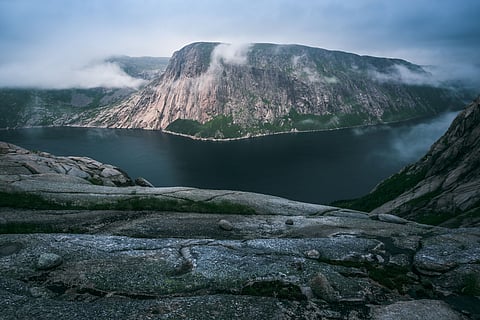


The Blow Me Down Wall, a huge granite cliff located in a remote fjord on the southwest coast of Newfoundland, Canada, the area that is not being declared a National Marine Conservation Area.
Photo: Adobe Stock.

In a statement from its Ministry of Environment, Conservation and Climate Change, the Government of Newfoundland and Labrador announced that it will not support a National Marine Conservation Area (NMCA) in the fjords of its southern coast, as well as the proposed redesignation of Sandbanks Provincial Park as a National Park.
The Ministry's head, Chris Tibbs, reported that the Provincial Government has terminated the Memorandum of Understanding (MoU) relating to the feasibility assessment of both proposed areas and that the other signatory parties, including the Government of Canada (Parks Canada), Miawpukek First Nation, Qalipu First Nation and the Town of Burgeo, have been formally notified.
In its update note, Newfoundland's Ministry of Environment, Conservation and Climate Change stated that its position has been clear that it cannot support the establishment of an NMCA on the island's south coast due to the potential risk it would pose to aquaculture, fishing and mining operations, as well as the impact on the communities that depend on them.
The Government of the Canadian province highlighted that protecting the environment while fostering economic development requires "careful balance," noting that it is committed to safeguarding natural ecosystems while supporting sustainable industry, trade and community growth.
"This government is committed to strengthening conservation efforts and protecting our province's environment," Newfoundland's Minister of Environment, Conservation and Climate Change stated.
"However, given the potential risk to aquaculture, fishing and mining sectors and the viability of the communities who rely on them, the Provincial Government is unable to proceed with the feasibility assessment of a National Marine Conservation Area on the south coast of the island and redesignation of Sandbanks Provincial Park," Chris Tibbs added.
The MoU that the current Progressive Conservative government of Newfoundland has now terminated was signed in June 2023 by the previous Liberal Party executive to initiate, as said, a feasibility assessment to establish the south coast fjords as a new National Marine Conservation Area.
At the time of its signing by the then Minister of Environment and Climate Change of the Province of Newfoundland and Labrador, Bernard Davis, the declaration was described as a "vital next step in the process to safeguard marine and coastal waters in Canada."
Even more, it would contribute to the Government of Canada's commitment to protect biodiversity and conserve 25% of marine and coastal areas by 2025, and 30% by 2030.
"The South Coast Fjords area is among the most productive marine environments in Atlantic Canada and is economically, culturally, and historically important to the region's Indigenous and coastal communities," the statement said at the time.
The study area described in the MoU encompassed 9,114 square kilometers, including Sandbanks Provincial Park, located on the south coast of Newfoundland.
It further defined the area as a biodiversity hotspot due to its wide range of coastal and marine ecosystems, and added that the coasts and waters are home to dolphins, porpoises, and many endangered species, including Atlantic cod, redfish, leatherback sea turtles and piping plovers and serves as a critical migration route for over 20 species of whales.
Regarding the reactions following the decision, the Newfoundland Aquaculture Industry Association (NAIA) expressed satisfaction that the Progressive Conservative government had fulfilled its election commitment to withdraw from what it called "a proposed economy-stifling National Marine Conservation Area on the province's south coast."
In NAIA's view, the MOU to establish this 6,500 km2 NMCA process led by Parks Canada risked crippling the local economy on the south coast, and the withdrawal from this process by the Provincial Government demonstrates that current Premier Tony Wakeham is putting local people first.
"With this decision today and by continuing to work with industry and community leaders, we can ensure aquaculture and other industries such as the fishery are a part of a more prosperous and resilient future for southern Newfoundland," said Executive Director of NAIA, Keith Sullivan.
For its part, the Fish, Food and Allied Workers union (FFAW-Unifor), also welcomed the decision it delivered on a clear commitment made by the Progressive Conservative Party during the recent election and demonstrated that Premier Wakeham and his government "are prepared to act decisively" in support of the province's fishing industry and the coastal communities that depend on it.
FFAW-Unifor added that, from the outset, the NMCA proposal threatened the owner-operator fishery, offering no evidence that it would achieve significant conservation results. The union also stated that Newfoundland and Labrador's fisheries are already sustainably managed in collaboration with harvesters and Canada's Department of Fisheries and Oceans, and further restrictions would only undermine livelihoods while allowing other industrial activities to continue within the same area.
"This announcement is an important step in pushing back against baseless marine closures that unfairly target fish harvesters under the guise of conservation," said FFAW-Unifor Secretary-Treasurer Jamie Baker. "Fish harvesters have led the way in sustainable fisheries management and deserve decisions based on real science, fairness, and transparency instead of ideology."
Unlike fish farmers and fishermen, the other signatories of the Memorandum of Understanding were disappointed with the change of course by the Ministry of Environment, Conservation and Climate Change of Newfoundland and Labrador.
This was the opinion expressed, for example, by Trevor Green, Mayor of Burgeo, the municipality that signed the MoU. Speaking to local media outlet CBC News—Canada's public broadcasting corporation—Green stated that they had asked Minister Tibbs to see the data on which the decision was based, and that Newfoundland's Minister of Environment, Conservation and Climate Change was unable to provide it.
"Our government says, 'We're here for all Newfoundlanders and Labradorians,' and here's a town that took initiative on their own to create some economic development, and put ourselves on the map, and revitalize our community, and the government's pulled the rug out from under our feet," he told CBC News.
Nevertheless, Burgeo Mayor also stated that any development would have included industry and harvester voices as part of a management board, and that the town wouldn't have moved forward if those voices weren't included. "I still feel there's a lot of negotiations and conversations to be had before we kill the idea," Green added.
Meanwhile, in statements to the same media outlet, Brad Benoit, Chief of Miawpukek First Nation, stated he had a feeling for some time that the project wouldn't move forward, and that he believes it's dead in the water.
"I'm not sure how we're going to reconvene, or how we're going to come back on this," Benoit told CBC News. "I hope there's a way that we can come to an agreement where industry and conservation can work together as one, instead of fighting against each other," the Chief added.
