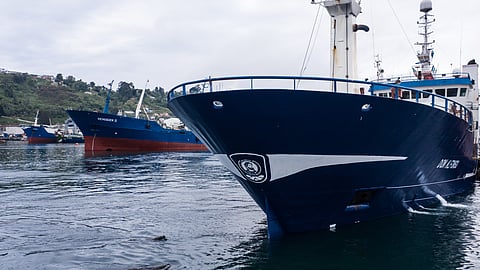


'Don Alfonso', one of the fishing vessels belonging to the Chilean seafood company Blumar.
Photo: Blumar.

Blumar announced it has sued the Chilean State due to the effects of the Fisheries Fractioning Law enacted in 2025 on the industrial fishing sector. The Chilean seafood company argued that the new law affected the regulatory framework established in 2013, which "set clear conditions for operation and fractioning until at least 2032," without providing compensation for the change.
In its lawsuit, Blumar argued that the legislation passed in 2013 represented a significant modernization of the national fishing system. Under this legislation, the industrial sector, availing itself of a regulatory framework expressly established by the State, renounced indefinite authorizations, replacing them with licenses with a fixed term and specific operating conditions for 20 years, "promoting a more sustainable, stable, and regulated use of resources, under explicit and known rules."
As the company explained now in its statement announcing the lawsuit, it was in the context of this legislative framework—which included quota rules projected until at least 2032—that it, like other fishing companies, made decisions regarding investment, employment, and regional development.
Now, Blumar pointed out, the new regulations modify the established regime without providing for compensation mechanisms, which, in its view, constitutes a serious financial impact, equivalent to regulatory expropriation, violating essential principles of legal certainty that the State must guarantee.
In its statement, the Chilean seafood company claimed that the financial effects of the amendment to the previous statute are severe. It has therefore entrusted its assessment to expert professionals, who, in order to calculate it, have considered variables such as the anticipated reduction in quotas, the impact on rights originally granted, and new economic burdens resulting from the regulatory change.
Thus, preliminary studies by these professionals have estimated the loss at around USD 216 million, which, according to Blumar, "certainly affects the company's sustainability and, obviously, future investment projections."
The resource most affected by this new fractioning, said Blumar, is jack mackerel, which will require a reassessment of its development plan in the Biobío region. The company specifically mentioned a project in Coronel—a commune in southern Chile, belonging to the province of Concepción, Biobío region—which involves investments of around USD 45 million and the creation of 250 new direct and indirect jobs.
Jack mackerel is an important resource for the Chilean seafood company. For example, in its latest quarterly results presentation for Q3 2025, a 23% increase in revenue from frozen jack mackerel kept the cumulative revenue of its fishing segment relatively stable, with an increase of USD 2.3 million, equivalent to 1%, after a year of lower prices for fishmeal, which fell by 18%, and fish oil, which fell by 51%.
Blumar, which recalled that it has 77 years of experience, a presence in more than seven regions of Chile, more than 1,000 workers in its fishing segment, and nearly 8,000 beneficiaries in community projects in different municipalities across the country, stated that it carries out "essential work" with resources such as jack mackerel, under sustainability standards and scientific regulation.
"We are a responsible, serious, and professional company. We must protect not only the interests of our shareholders, but especially those of our workers and the communities where we operate. When rules established by law are unilaterally altered, the institutional path is to exercise the actions that our legal system provides for," the company noted.
Finally, Blumar reiterated in its statement its commitment to sustainable fishing development, "with clear and stable rules that allow for the compatibility of investment, regional employment, and resource protection."
As WeAreAquaculture reported last year, in 2024, the company achieved significant improvement in sustainability, obtaining 73 points in the Corporate Sustainability Assessment (CSA), the evaluation of companies in the food category conducted by the risk rating agency S&P Global, which annually recognizes industry leaders by measuring them across environmental, social, and governance dimensions. The result represented a 74% improvement in just three years.
