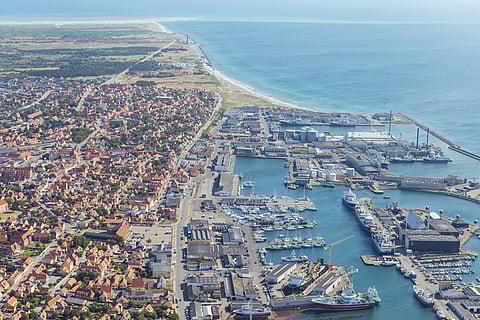


Aerial view of the Port of Skagen
Photo: Adobe Stock

Denmark’s largest fishing harbour, Port of Skagen, is beginning to phase out diesel-powered generators during the unloading of pelagic fish, as part of a move towards cleaner energy, supported by European Commission funding.
The Danish port is an important hub for the North Atlantic pelagic fleet. These large pelagic vessels, landing species such as herring, sprat and blue whiting, typically require substantial amounts of electricity while unloading their catch, a process that can last from 10 to 30 hours. Until now, this energy demand has largely been met by onboard diesel generators, contributing to carbon dioxide emissions, air pollution and noise in and around the port area.
According to the European Commission’s Directorate-General for Maritime Affairs and Fisheries, the Danish port's transition to shore-based electricity aims to both cut emissions and improve conditions for port workers and nearby residents, at the same time as supporting the EU’s wider objective of reducing the environmental footprint of the fishing sector.
The Lingbank, one of the vessels retrofitted for shore power infrastructure.
Photo: Skagen Havn / European Commission
The initiative is being delivered through a partnership between the Danish Pelagic Producer Organisation and the Port of Skagen. The project has been structured in three phases: the installation of shore power infrastructure, the retrofitting of vessels to connect to the system, and upgrades to local grid capacity.
A news release by the European Commission quotes Jesper Rulffs, business developer at the port, as saying the shift from diesel to shore power during landing operations means “we achieve reductions in CO₂ as well as SOₓ, NOₓ and particulate emissions.”
“This improves local air quality and strengthens the long-term competitiveness of the port by offering cleaner and more efficient services to the fleet,” Rulffs added.
According to the Commission, two vessels have already been retrofitted to use the new shore power system, with a third currently being adapted. Once the system is fully operational, unloading activities will run entirely on electricity supplied from shore, eliminating the need for generators during landing operations.
Both the port and vessel owners had to commit to the project for it to proceed, with the port requiring assurance that the infrastructure would be used and operators seeking confidence in the reliability of the electricity supply. According to the Commission, the mutual commitment was central to making the investment viable.
Estimates provided as part of the project suggest that individual vessels could reduce annual diesel consumption by around 3–8%.
The Port of Skagen, Denmark's largest fishing port, which is used by 5,500 fishing vessels and around 700 merchant vessels per year, has set a goal of becoming CO₂-neutral by 2030. The electrification project is billed as a key component of that strategy, with the Port having already invested more than DKK 26 million (approximately EUR 3.48m / USD 3.76m) in its onshore power supply project, according to the project website.
