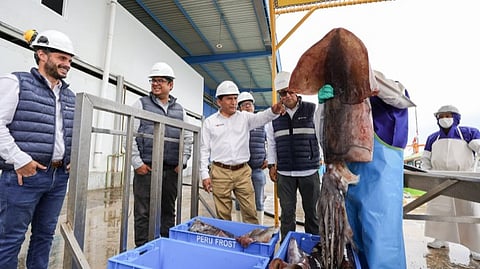


Peru's Minister of Production, César Quispe Luján (center), during his visit to the Peru Frost plant.
Photo: Produce.

Although Peru is globally known for its anchovy processing industry for indirect human consumption—that is, for the production of fishmeal and fish oil—the most recent data provided by the Peruvian Ministry of Production (Produce) indicate that the other fishing subsector, that of direct human consumption, is also establishing itself as one of the country's key economic drivers.
According to Produce, in Peru, the fishing sector for direct human consumption has around 225 industrial establishments in operation and generates more than 74,000 jobs throughout the country.
However, this dynamism, which is key to job creation, does not stop there, but also extends to the financial sector and, more specifically, to the inflow of foreign currency into the country, as detailed by the new Peruvian Minister of Production, César Quispe Luján.
During a working visit to the Piura region, the Minister of Production said that, at the end of the third quarter, the fishing industry for direct human consumption in Peru exceeded USD 1.5 billion in exports.
Quispe Luján added that projections indicate that, by the end of 2025, exports from this subsector could reach USD 2.13 billion, driven by products such as tuna, shrimp, trout, and jumbo flying squid.
The latter species, the jumbo flying squid, is one of Peru's most important fisheries this year. The abundance of the resource has been such that, following the scientific advice of the Peruvian Sea Institute (Imarpe) to ensure its sustainability and, with it, the country's food security, on November 21, the Ministry of Production ordered the resumption of the fishing season, establishing a supplementary quota of 38,859 tons.
"The growth of the sector is the result of joint efforts between industry, artisanal fishermen, and the government, strengthening the production chain and the international competitiveness of Peruvian products," said the Peruvian Minister of Production.
As mentioned above, César Quispe Luján made these statements during a visit to the Piura region in the northwest of the country, whose economy is mainly based on artisanal fishing. There, as part of his agenda, the Minister visited two seafood processing plants for direct human consumption in Paita.
Produce said that the Minister's goal with this working visit was to learn more about their operations and technical advances, but also about their needs in order to continue promoting fishing activity in the region.
The Minister of Production inspected Sea Frost's facility, where improvements in process control and quality standards were evaluated. Produce highlighted that this is a company supported by the Agroindustrial Center for Productive Innovation and Technological Transfer (CITE) in Piura, which provides technical advice, innovation, and technological services to improve its productivity, quality, and competitiveness.
The head of Produce also visited the plant of Perú Frost, a company that has expanded its portfolio with products such as jumbo flying squid, perico (mahi-mahi), scallops, and imported shrimp, consolidating its position as a strategic player in job creation and industrial development in the region.
Finally, Quispe Luján also visited other key production areas located in the port zone to analyze coordination with artisanal fishermen and the logistical challenges associated with the cold chain.
