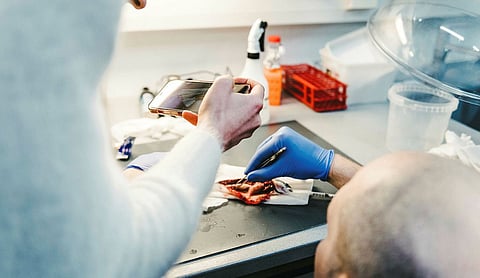


Autopsy of fish from a previous experiment in the SpiroFri project.
Photo: Christine Fagerbakke / HI

A new report from the Institute of Marine Research (IMR) of Norway examines how sea trout and salmon respond differently to the parasite Spironucleus salmonicida and how this impacts the salmon aquaculture sector economically.
The main conclusion of this study highlights the ability of sea trout to become infected with the parasite without developing disease, unlike salmon, in which it causes illness and death. In addition, sea trout can eliminate the parasite.
Researcher Bjørn Olav Kvamme based his studies on the parasitic disease outbreak that occurred in fish farms in Finnmark in 2022, which caused severe suffering in salmon and significant economic losses, estimated at around one billion Norwegian kroner (approximately €85 million) in the most recent outbreak.
"From the blood, the parasite can move on to any organ; it has been found in the eye, the gallbladder, the heart, and the brain. It creates abscesses and lesions in both internal organs and muscles, and there is currently no treatment for the disease," detailed Kvamme.
Trout and salmon were introduced into water containing parasites cultured from the Finnmark outbreak and were then transferred to new tanks. Blood samples were taken after 4 and 9 weeks. When the experiment ended after 17 weeks, all fish were sacrificed and examined.
"In comparison, very few of the trout were infected, and none of them became ill. After 17 weeks, none of the trout from the infection pool had the parasite anymore. This indicates that spironucleosis is not a threat to this species and that it is quite resistant," says Kvamme.
Furthermore, the researcher states that trout also transfer parasites to salmon that were not previously infected, thereby acting as carriers of the infection in the sea.
This initiative is part of the SpiroFri project, funded by the Fisheries and Aquaculture Industry Research Fund (FHF). The project partners are Nofima, the Norwegian Veterinary Institute, PSK v/Erik Sterud, Grieg Seafood ASA, Uppsala University, and IMR.
