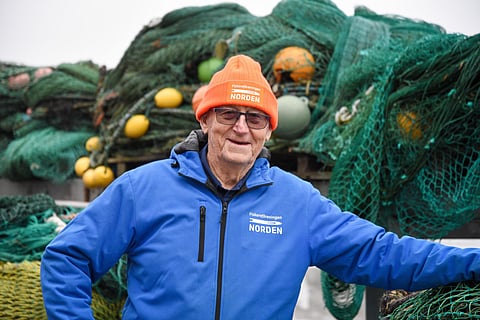


Sixten Söderberg in front of traditional nets.
© Sotenäs kommun

A consortium of Swedish partners, with financial support from the European Union, has launched the 'Light Trawling' project to test whether light can guide shrimp into a trawl net, helping the gear remain off the seabed.
As the system is smaller and lighter than conventional trawl gear, it offers significant environmental and economic benefits. By reducing water resistance, it lowers fuel consumption and decreases wear and tear on fishing equipment, while also helping to minimise the impact on the seabed.
The project was born when one of FF Norden's active members, Sixten Söderberg, got in touch with an Icelandic team that had developed a system using light to guide catches into a net. Their collaboration inspired the idea of adapting this innovative approach to Swedish fishing conditions.
"Innovation is the way forward. If we want to secure a future for our fishers and for the fishing industry as a whole, we need to do something," assured Söderberg.
The Swedish applied research and innovation institute Chalmers Industriteknik has also joined the initiative, contributing its expertise in the blue and circular economy to help ensure that the new fishing gear is environmentally sustainable without compromising the economic viability of the fisheries sector.
EU funding has enabled the implementation of the necessary trials to adapt the system to the specific characteristics of the Swedish seabed and to the operational requirements of different types of fishing vessels.
Among the key aspects being assessed are the weight each light unit must have to remain stable in varying currents, how water density and visibility affect the performance of the lights and the shrimp's response, and how high above the seabed the gear can operate while maintaining effective catches.
"We need a living ocean. There has to be something left for future generations, and to make that happen, we need to do things differently," expressed Söderberg.
