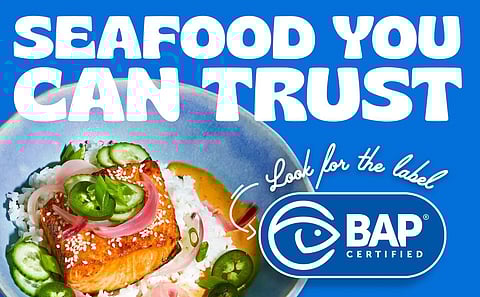


Image from the 'Seafood You Can Trust' campaign, based on data from the report, which will be launched in early 2026.
Photo: Global Seafood Alliance (GSA).

New research conducted by GlobeScan -a consulting firm specializing in trust, sustainability, and engagement- for the Global Seafood Alliance (GSA) showed that more than four in ten consumers say they intentionally buy fish and seafood products with eco-labels and, specifically, that two-thirds of consumers express confidence in the Best Aquaculture Practices (BAP) label, with Spanish consumers reporting the highest level of trust in BAP.
The independent survey conducted for the report polled at least 1,000 consumers in five key countries: Canada, France, Spain, the United Kingdom, and the United States. More than half of them, 53%, also said that the BAP label would influence their decision to buy or consume a seafood product.
"It's encouraging to see consumers recognizing the value of responsible seafood," said Gayle Chong, principal at GlobeScan. "Credible certification plays a vital role in guiding purchasing decisions and sends a powerful signal to the industry that integrity matters."
The survey sought to understand purchasing decisions related to seafood products and certification labels such as Best Aquaculture Practices, as well as how to inform and engage consumers about responsible sourcing.
Thus, the consumers surveyed by GlobeScan for the GSA were those who had purchased seafood products in the last six months and/or consumed fish or shellfish in the last year, meaning that the data corresponds to 2025.
According to the survey results, the main concerns of seafood consumers globally are taste, safety, health, and price.
Furthermore, almost half of them said that the fact that seafood produced in a way that is safe for consumption is an important aspect of farmed seafood. More than half of the consumers surveyed in the five countries where the study was conducted—specifically 53%—said they want to avoid farmed fish from irresponsible companies.
The GlobeScan report also noted that when asked which sources of information on responsible seafood were most trustworthy, consumers cited fishermen/fishmongers, certification organizations, scientists, and chefs as the most trusted.
The research also showed that the most effective channel for reaching consumers with messages about responsible seafood products is product packaging.
Dedicated to promoting responsible practices in the seafood industry through education, advocacy, and third-party assurance, GSA has become the leading provider of assurance for wild and farmed seafood products worldwide through the development of its certification programs.
Its work covers the entire spectrum of responsibility, from environmental responsibility and social responsibility to food safety, but also raising consumer awareness of the importance of consuming products that comply with that responsibility.
Therefore, based on the results of the survey conducted by GlobeScan, the Global Seafood Alliance has announced that in 2026 it will launch a new consumer marketing campaign under the slogan 'Seafood You Can Trust'.
"We are excited to leverage this research to guide our 2026 consumer campaign," said Elise Avallon, GSA Marketing Director. "Our chosen tagline, 'Seafood You Can Trust', was one of the top chosen taglines by consumers across all countries – a simple yet effective message."
"We look forward to working with retail and food service partners, as well as BAP-certified producers, to bring this campaign to life," Avallon concluded.
The campaign, which will be launched in early 2026 with the aim of increasing brand awareness of the BAP label in key markets, is open to participation by retailers, food service companies, or producers with BAP certification, so GSA invites everyone to join.
GlobeScan and GSA recently hosted a webinar providing an overview of the study's key findings. Those interested in getting involved in the campaign who would like more information about the results and were unable to attend at the time can now watch it on the Global Seafood Alliance YouTube channel.
