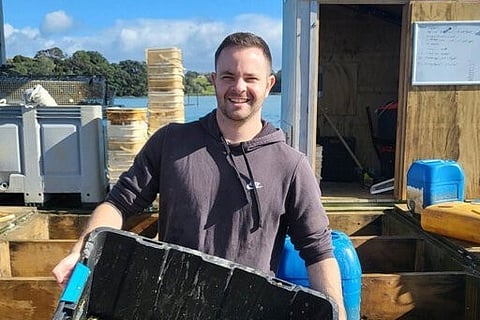


"His expertise will help ensure our research delivers real benefits for producers," Gregg Arthur, Shell-volution's Project Director, said of Dr Brad Skelton.
Photo: Shell-volution / University of the Highlands and Islands (UHI).

Shell-volution, a publicly funded initiative to transform Scotland's mussel farming sector, has announced the appointment of the internationally recognized mussel aquaculture researcher Dr Brad Skelton, Research Fellow at the University of Auckland, New Zealand, as Independent Scientific Advisor for a one-year pilot.
The announcement, issued by the UHI—University of the Highlands and Islands, which leads the project in partnership with the Scottish mussel industry—highlighted that he brings internationally recognized expertise from one of the world's leading mussel farming nations.
Developed under the Islands Growth Deal program—a ten-year investment plan jointly funded by the UK Government, the Scottish Government, the three Island Councils (Shetland Islands, Western Isles and Orkney Islands) and partners from the public, academic, community and business sectors—Shell-volution has a grant of GBP 4.4 million to drive innovation and growth in Scotland's mussel farming sector.
The funding targeted at research and development to strengthen the future of Scotland's mussel industry includes delivering research and practical innovation to improve the reliability of wild mussel spat recruitment, enhance farming practices, and support the sector's future sustainability and productivity.
At the same time, Shell-volution also seeks to deepen its understanding of the area's marine environment and share knowledge across the sector.
Proposed as a multi-phase initiative, the program began planning in 2021 with its inclusion in the Islands Growth Deal, although its large-scale deployment and development officially started in late 2024, and its full implementation took place in 2025.
As already mentioned, the Shetland Islands-based project brings together mussel farmers, public bodies and industry partners who, under the helm of UHI, aim to offer practical solutions to the sector's real-world challenges.
In the current phase, Dr Skelton joins precisely to, through his independent scientific advice, constructive challenge and an international perspective, help ensure Shell-volution's research, innovation and knowledge exchange activities deliver practical benefits for Shetland's mussel sector and support the long-term growth of Scotland's shellfish industry.
As Independent Scientific Advisor, he will advise on the project's research pipeline, review the feasibility and quality of proposed work, support technical scrutiny of project outputs and help the team draw on successful approaches from established mussel farming industries overseas, particularly New Zealand.
To this end, thanks to his work in close collaboration with New Zealand's renowned mussel farming sector, Dr Skelton has extensive experience in applied aquaculture research and knowledge exchange.
According to UHI's release, Shell-volution's new Independent Scientific Advisor has already held virtual meetings with the team and is scheduled to visit Shetland in September 2026.
"We are delighted to welcome Dr Skelton to the project. His international experience of applied aquaculture research and close collaboration with New Zealand's mussel farming industry will bring valuable independent insight as we develop practical solutions for Scotland's shellfish sector," said Project Director, Gregg Arthur, commenting on the appointment.
"His expertise will help ensure our research delivers real benefits for producers and supports the long-term growth of the industry," the leader of Shell-volution added.
Last year, Scottish shellfish producers set a new production record with 12,303 tons of common mussels produced for the table market. Shell-volution expects to help local businesses improve farming techniques and thus participate in the projected increase in production, expected to reach 18,000 tonnes by 2037.
