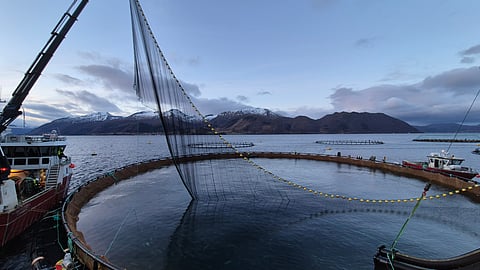


Ode's site in Alida, Volda municipality, in western Norway.
Photo: Ode.

Earlier this year, Ode announced the launch of the world's first commercial deep-sea cod farming operation. The Norwegian fish farmer then lowered the cod to deeper, colder water layers using a fully submersible cage system at commercial scale. Now, that fish has been harvested and commercialised, marking the first time that deep-sea farmed cod has reached the market.
It's not just a first for Norway; it's a world first, marking a milestone for the future of cod farming. As CEO Ola Kvalheim told WeAreAquaculture in an interview, what Ode is doing now will pave the way not only for the company but also for other producers coming on the heels of the handful of companies currently involved in cod farming in Norway. With every step they take, these pioneering companies are building an entire culture around farmed cod.
As Ode explained in its note on the milestone achieved, deep farming allows fish to remain in cooler, more stable water layers throughout the year, improving temperature control and creating more predictable production conditions.
At the company's site in Alida, Volda municipality, in western Norway, the cod was produced in a Nautilus submersible cage supplied by AKVA group, specially designed for deep-water operations, aiming to improve fish welfare and production conditions. It was then processed at Ode's own harvesting plant.
The results of farming in these submersible cages show solid growth performance and better control of maturation, one of the main concerns in the sector, which recently led the Norwegian Government to introduce new rules for cod farming.
"Based on the results we're seeing, deep farming delivers both strong growth and an even more effective tool for controlling sexual maturation. At Ode, we firmly believe that innovative technology combined with strong biological expertise is key to success in aquaculture," said Ola Kvalheim.
"This has been incredibly exciting to be part of. We've followed the fish closely throughout the entire period, and it's genuinely rewarding to see how well this has worked in practice. It's a team effort we're very proud of," added Andor Bjerke, Site Manager at Alida.
Andor Bjerke, Site Manager at Ode's cod farm in Alida.
Photo: Ode.
Norwegian wild cod coastal stocks are at historically low levels, and the outlook is not promising. In the recent fishing agreements reached by Norway for 2026, cod quotas have been cut in the agreements signed with the EU and the UK, as well as in the agreement signed with Russia.
Before that, just the prospect of significantly lower cod quotas next year had already been reflected in its export price in November, a period in which exports of fresh farmed Norwegian cod increased by 60%, and in which farmed cod accounted for 51% of the value of fresh cod exports.
Thus, with the availability of wild cod becoming increasingly uncertain due to declining populations, farmed cod produced in submerged systems has contributed to a more predictable supply for seasons such as Christmas.
Even more, Ode highlights in its note that, in the most recent risk assessment by the Norwegian Institute of Marine Research, submerged farming stands out as a promising technology for cod aquaculture, contributing to a more stable and predictable supply.
Ode is currently the only producer globally using deep farming technology for cod. When it announced its launch in May, its CEO stated that if performance targets were met this year, the company would implement the solution at other sites suitable for this technology.
"Following these results, we are now assessing expanded use of deep farming and are already in dialogue with our technology partners on how this can be scaled further," Kvalheim said now.
