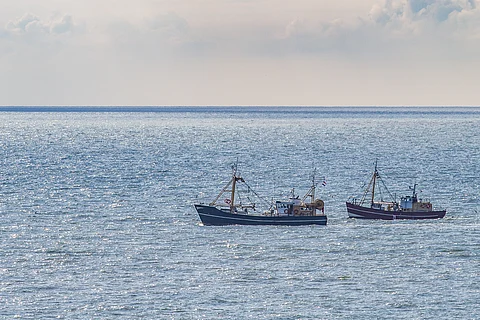


Fishing vessels in the North Sea.
Photo: Adobe Stock.

Norway, the EU and the UK have reached a tripartite agreement on the management and quota allocation of six shared fish stocks in the North Sea for 2026.
Under the deal, which covers cod, haddock, saithe, whiting, plaice and herring, the EU will receive a total of 341,771 tonnes, the UK 278,016 tonnes and Norway 168,312 tonnes.
"The agreement we have now entered into means that we agree on quotas for stocks that we manage together in the North Sea and that are important to all three parties. The agreement will contribute to sustainable management," said Norwegian Fisheries and Oceans Minister Marianne Sivertsen Næss, announcing the outcome of the negotiations.
The agreement imposes some of the most far-reaching measures seen in recent years for cod, following ICES advice that catches should ideally be close to zero in 2026.
During the negotiations, the three parties acknowledged the gravity of the stock’s condition and agreed a total allowable catch of 14,034 tonnes for Northern Shelf cod, allocated across the North Sea, Skagerrak, West of Scotland and the eastern English Channel - a 44% reduction compared with the previous year.
In the North Sea, Norway's cod quota is set at 1,898 tonnes, with 3,984 tonnes allocated to the EU, and 5,282 tonnes to the UK.
The quota cut forms part of a new multi-year plan to reduce fishing pressure and rebuild all three cod sub-stocks in the North Sea.
Norway, the EU and UK all agreed to maintain and expand closed areas protecting cod spawning grounds, while also exploring further actions such as additional spatial closures and the use of more selective fishing gear.
For North Sea herring, the parties agreed to a 2026 TAC of 328,566 tonnes -- a 20% reduction from 2025 -- and adopted a new long-term management strategy, bringing in a single overall TAC and fixed sharing keys between the parties, covering the North Sea, Skagerrak–Kattegat and the eastern English Channel.
Under the agreement, Norway will receive 91,013 tonnes, the EU 174,140 tonnes and the UK 63,413 tonnes in 2026.
The new approach aims to simplify management and keep catches within sustainable limits, with closer monitoring of juvenile catches and stricter control and weighing procedures, the negotiators said.
The agreement also recognises ongoing concern about Western Baltic spring-spawning herring, which are still taken as part of the North Sea fishery, and commits the parties to further measures in 2026 to limit these catches, including possible new area and seasonal restrictions in Norwegian waters.
The negotiations also resulted in agreement on the 2026 TACs for haddock, saithe, plaice and whiting, with most quotas decreasing in line with scientific advice.
Haddock will see a modest reduction of 3.7%, with a total TAC of 108,301 tonnes, while saithe quotas will see a sharper cut of 25%, bringing the TAC to 59,661 tonnes, and plaice will be reduced by 7.2% to 163,951 tonnes. Whiting is the only jointly managed stock to increase, with a 2026 TAC of 198,609 tonnes, reflecting improved stock conditions.
Beyond the jointly managed species, the delegations noted recent scientific work on anglerfish and hake, and agreed to begin discussions in 2026 on how these stocks could be jointly managed in future.
All three parties also committed to further development of monitoring, control and surveillance across all shared fisheries, including updates to vessel tracking, electronic reporting and inspection practices.
