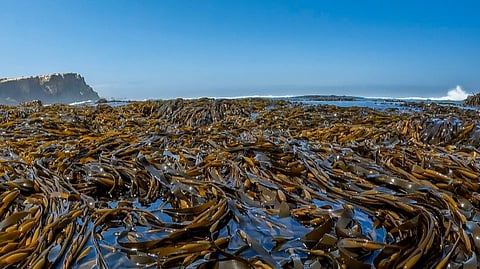


The Peruvian Minister of Production, César Quispe Luján, said that this regulatory update on macroalgae is not an obstacle but an opportunity.
Photo: Produce.

Intending to strengthen the sustainable management of this marine resource, shortly before the end of the year, Peru's Ministry of Production (Produce) approved a decree to amend the Marine Macroalgae Fishing Regulations.
With the new regulation, Produce not only aims to strengthen the sustainability of marine macroalgae, but also to improve the traceability of the resource and provide greater regulatory clarity for its artisanal and industrial processing, so that both productive development and protection of the marine ecosystem benefit.
"Peru is a megadiverse country, and marine macroalgae play a fundamental role both in the balance of our ecosystems and in the economic development of thousands of families. With this regulation, we are standardizing the growth of the sector, ensuring sustainability, legality, and better conditions for productive activity," said Peruvian Minister of Production César Quispe Luján.
Among the main changes is the updating of provisions on access to macroalgae processing, differentiating more precisely between artisanal and industrial activities and establishing clear rules according to the destination of the product, whether for direct human consumption, indirect human consumption, or non-food purposes.
Likewise, the decree issued by the Peruvian Ministry of Production reinforces the role of oversight and control of the legal origin of macroalgae through a certificate of origin, which must accompany them throughout the entire production chain.
In addition, the new regulations also promote the gradual transition of artisanal macroalgae processing to industrial schemes, providing a period of up to 24 months for the adaptation of certain licenses, without affecting the continuity of operations during that period.
According to Produce, this latest measure seeks to promote regularization, technological improvement, and added value, while respecting the powers of regional governments.
"This regulatory update is not an obstacle, it is an opportunity: it allows us to organize the sector, close loopholes for informality, and strengthen the competitiveness of our macroalgae in the markets, with clear and predictable rules," Quispe Luján emphasized.
Moreover, the new regulations also established the creation of a national database of artisanal macroalgae processing plants, as well as digital mechanisms that, in coordination with regional governments, will improve the supervision, control, and traceability of the resource.
With these changes, Peru not only reaffirms its commitment to the sustainable management of its hydrobiological resources, as it has been doing with fish species such as anchovy and jumbo flying squid, but also promotes the country's economic development.
According to a 2023 report from the World Bank, emerging global seaweed markets held the potential for substantial growth, projected to reach as much as USD 11.8 billion by 2030.
A year later, in 2024, the 'Seaweed Market Forecast 2023-2029' report already predicted that seaweed revenues would reach almost USD 18.77 billion by 2029.
While waiting to see what happens in Peru following these new measures, from January to July 2025, when artisanal fishing landings grew by more than 50% in the country, and the value of artisanal fishing exports increased by 142.1%, along with horse mackerel, mackerel, red mullet, hake, anchovies for direct human consumption, and jumbo flying squid, seaweed was already one of the species that contributed most to this growth.
