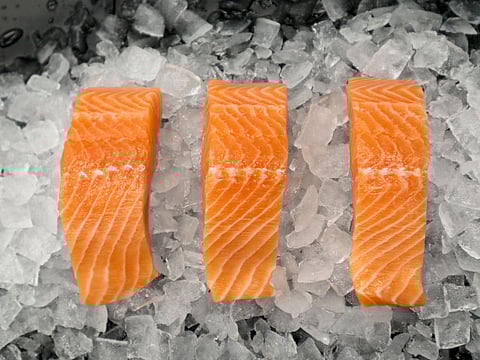


"We are ready to move quickly once the deal is in force and position Scotland as a premium supplier in this fast-growing market," said Salmon Scotland's CEO.
Photo: Salmon Scotland.

Following the free trade agreement signed last year between the UK and India, Salmon Scotland described the market opening to Scottish salmon exporters as the "lucrative Indian market." Now, the trade body has put a figure on the potential profit: exports to India could grow by up to GBP 130 million over 10 years.
Currently, Scottish salmon faces a 33% import tariff in India, but this barrier is expected to be removed by the end of this year when the agreement between the two countries comes into effect. According to Salmon Scotland, under high-growth projections, this paves the way for exports that could exceed GBP 30 million annually by the end of the decade, "creating inward investment and well-paid jobs in Scotland."
According to figures from the International Monetary Fund, India is the world's fourth-largest economy, with a GDP of USD 4.19 trillion, and also the fourth-largest consumer market, with a population of 1.45 billion people.
There, most of the fish consumed is locally sourced, but the demand for premium imported seafood is growing rapidly in major cities such as Delhi and Mumbai, and it is precisely among these consumers that the global reputation of Scottish salmon is expected to be strongly embraced due to its quality and high production standards.
So far, Scottish salmon exports to India have been modest, at around 70 tons per year worth approximately GBP 0.5 million until 2022. However, the trade body interprets this positively, as an indicator of initial demand and already established supply chains.
"Strong distribution links and reliable cold-chain logistics will be crucial to turning that opportunity into lasting exports," it noted in its release.
In fact, this new analysis by Salmon Scotland states that India could emerge as a significant new export destination even under prudent growth assumptions, although its high-growth projections exceed 3,500 tonnes annually towards the end of the decade.
The trade body study modelled three growth scenarios. In the worst-case scenario, which the report calls "low growth," cumulative growth of approximately GBP 21 million is projected over 10 years. In the next scenario, "medium growth," the calculated growth is approximately GBP 70 million cumulative over 10 years. The third and final scenario, "high growth," projects cumulative growth of approximately GBP 131 million over those 10 years.
Salmon Scotland's India export modelling.
Graphic: Salmon Scotland.
"The UK-India trade deal taking effect later this year presents a major opportunity for Scottish salmon – opening up another key market for exporters while boosting the economy," said the UK Parliamentary Under Secretary of State for Scotland, Kirsty McNeill, commenting on Salmon Scotland's study.
"These figures highlight the sector's exciting growth potential as a result of the agreement secured by the UK Government," she continued. "With analysis showing India could become one of Scotland's top overseas markets for salmon by the mid-2030s and eventually bring in GBP 30 million a year, this deal marks the beginning of a pivotal expansion into one of the world's fastest-growing economies."
"We are ready to move quickly once the deal is in force and position Scotland as a premium supplier in this fast-growing market," stated, for his part, Tavish Scott, CEO of Salmon Scotland.
Scottish salmon producers began preparing as soon as the agreement was signed, and last July they received a visit from the Indian High Commissioner, Vikram K. Doraiswami, who traveled to Scotland to learn more about the scale and quality of Scottish farm-raised salmon.
Now, Scott noted that Scottish salmon is already the UK's top food export, with international sales worth GBP 828 million last year and strong demand across Asia, where sales grew by 18%.
"India now represents the next major opportunity. With tariffs set to be removed, exports to India could deliver up to GBP 130 million over the next decade, supporting jobs and investment in coastal communities across Scotland," he said.
In Salmon Scotland's view, amid progress on a number of key free trade agreements, the opportunity in India is part of a broader push to expand Scottish salmon exports to other fast-growing markets in Asia and the Gulf.
With exports to China approaching GBP 100 million in 2025—it was the third largest destination market for Scottish salmon exports last year behind France and the U.S., specifically GBP 97 million, representing a 28% year-on-year increase—, for the trade body, what happened with the Asian giant is a demonstration of how quickly demand in Asia can grow once a market opens up.
Salmon Scotland believes India could follow a similar trajectory as its premium food market expands, but that capitalizing on these opportunities will depend on regulation that supports sustainable growth and investment.
"We've seen in markets like China how quickly demand can build once trade barriers fall. India has the scale and economic momentum to follow a similar path," Tavish Scott said.
In addition, as mentioned, the UK is also making progress in trade negotiations with Gulf states, including the United Arab Emirates (UAE) and Saudi Arabia, while a new agreement with South Korea has secured permanent tariff-free access for UK products.
Salmon Scotland noted that Scottish salmon exports to South Korea increased considerably before the pandemic, and better market access could help exporters capitalize on demand across Asia.
