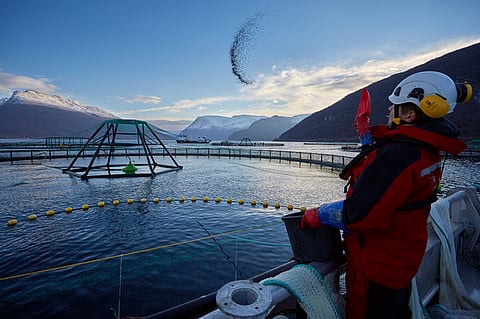


Nofima has analyzed the ripple effects of the aquaculture industry in Norway.
Photo: Nofima / Audun Iversen

A new analysis by Norwegian research institute Nofima shows that Norway’s Aquaculture Fund injected NOK 3.8 billion into 143 coastal municipalities in 2024, providing a significant boost to local economies - particularly in smaller communities.
Four municipalities received more than NOK 100 million each. Frøya and Nærøysund topped the list with more than NOK 150 million apiece, followed by Senja (NOK 127m), Hammerfest (NOK 121m) and Hitra (NOK 99m).
“For many municipalities, the Aquaculture Fund is an important contribution to the municipal economy,” said Nofima researcher Audun Iversen, who led the institute’s impact analysis of the aquaculture sector. In some cases, fund income corresponds to around one fifth of a municipality’s annual operating expenditure.
The Aquaculture Fund redistributes revenues from the farming industry -- including production fees and auctions of new aquaculture capacity -- back to coastal municipalities and counties. However, while 2024 was a strong year for payouts, the analysis warns against expecting similar distributions in the short term.
Payments in 2025 will total around NOK 1.4 billion, as they will be based solely on production fees. “What really benefits municipalities are the licence auctions, and these only take place every two years,” Iversen said, adding that fewer production areas may be eligible for growth in 2026, increasing uncertainty around future payments.
The analysis, funded by Norway's seafood research fund FHF, a state-owned entity that funds research and development for Norway's fisheries and aquaculture industries, shows that value creation in Norwegian aquaculture has risen sharply over the past 15 years. Since 2010, value creation has increased by around 270%, equivalent to average annual growth of about 10%.
Iversen said that, including ripple effects, value creation reached NOK 101 billion in 2024, a slight increase from the previous year.
"Value creation in the core business was somewhat lower, due to higher costs and reduced profitability in food fish production. However, much of the increased costs are found in the purchase of goods and services, which thus have greater ripple effects. Overall value creation was thus virtually unchanged," Iversen explained.
Aquaculture also made a substantial contribution to public finances, according to Nofima's analysis. In 2024, NOK 5.9 billion in corporate tax was paid from core farming activities, with a further NOK 2.5 billion coming from suppliers. The sector accounted for 3.9% of Norway’s total corporate tax take, despite representing just 1.3% of GDP.
"The fact that the industry's share of taxes can be so much higher than the industry's share of GDP is because farming is more profitable than other industries: they earn more money and thus pay more tax," Iversen pointed out.
The figures show that farmed salmon exports were worth NOK 122.6 billion in 2024, broadly unchanged from the previous year, while trout exports increased by 23% to NOK 6.8 billion.
"At the same time, there were important changes in the composition of exports, which have a major impact on the ripple effects," Iversen explained.
"Whole, fresh salmon still accounts for the majority of around 70 percent of the export value for Norwegian salmon. But fresh fillets increased by over three billion - to 21 billion, while frozen fillets increased by over one billion, to 11 billion. And this means more jobs," he added.
Meanwhile, Nofima found the proportion of salmon and trout processed domestically has risen from 14% in the early 1990s to 29% in 2024, underlining the aquaculture sector’s growing economic importance for coastal regions.
