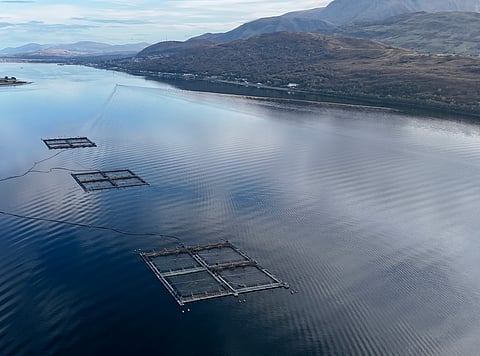


Mowi's Gorsten salmon farm in Upper Loch Linnhe, Scotland, where the escape occurred.
Photo: Mowi Scotland.

Following the salmon escape from Mowi's Gorsten farm in Upper Loch Linnhe on October 5, 2025, Mowi Scotland and the River Lochy Association have agreed to conduct a long-term, wide-ranging scientific study to examine the potential impacts caused by the incident.
Funded by Mowi, the study will also utilise the genetic expertise of the Institute for Biodiversity and Freshwater Conservation at UHI Inverness. The aim is first to monitor and then, where necessary, mitigate any adverse impacts on salmonid biology within the catchment area.
As a result of the extreme weather conditions experienced during Storm Amy on October 5, 2025, Mowi's Gorsten salmon farm in Upper Loch Linnhe, Scotland, recorded an escape incident in which an estimated 75,000 salmon with an average weight of 860 g escaped into the wild.
At the time of the escape, the fish were sexually immature and came from a recirculating aquaculture system (RAS), so a very low survival rate in the wild was expected, according to a joint statement issued by the River Lochy Association and Mowi Scotland.
Immediately after the escape incident, in consultation and coordination with the River Lochy Association, Mowi implemented a series of measures to try to mitigate the effects of the escape. The first and most prominent was the immediate recapture of fish that entered local and more distant rivers.
Because the escape occurred very close to the salmon and trout spawning season, and due to the rivers' height at the time, it was decided not to use nets, but to rod catch as many fish as possible. Thus, more than 100 anglers were deployed throughout the region and beyond.
All captures were reported on the Fisheries Management Scotland escapes reporting app. At the time of publication of the announcement by Mowi Scotland and the River Lochy Association regarding the study, a total of 440 catches had been reported, the vast majority in the lower reaches of the Lochy and Leven rivers, all of which were immature and weighed between 0.5 and 2.5 kg.
With this background, Mowi and the River Lochy Association have now agreed on the scope of the long-term study to monitor impacts from salmon escape from Gorsten farm in Upper Loch Linnhe.
Among the measures announced, the first will be that, in 2026 and 2027, scale samples will be taken from the majority of rod-caught adult returning salmon in both the Lochy and Leven rivers. These samples will be genetically analyzed in comparison with the farm stock to determine, if any, the level of farmed fish from this escape in adult salmon returning from the ocean.
In addition, in 2026, local teams of fisheries biologists will conduct timed electro-fishing surveys in all major salmon catchments in the Upper Linnhe region and collect fry samples for genetic analysis. This will constitute the baseline 'pre-incident' survey.
According to Mowi and the River Lochy Association, 58 known fry sampling points will be used, with a wide geographical distribution of sites in each catchment. Then, at each of these points, a minimum of 20 and a maximum of 30 fry will be sampled through non-lethal caudal fin clips taken from anaesthetised fish.
Through their respective spokespersons, both Mowi Scotland and the River Lochy Association have expressed their satisfaction with the proposed plan and their commitment to this long-term scientific study.
"Obviously an escape of farmed salmon into the wild is something that nobody wants to see," said Jon Gibb, Manager of the River Lochy Association and Director of the Lochaber District Salmon Fishery Board.
"But I am confident that between Mowi and the River Lochy Association, the local wild fishery management body, that we have designed a comprehensive three-year genetic monitoring plan that will definitively identify whether there will be any impact whatsoever from this unfortunate incident on the local wild salmon population," he added.
For his part, Stephen MacIntyre, Head of Environment at Mowi Scotland, stated that the company regrets this incident and acknowledges its responsibility to monitor and assess the potential for any adverse impact on local wild salmon populations.
"Using this scientific approach, the monitoring study will determine whether there is evidence of any changes in the genetic composition of wild salmon arising from the escape incident. We look forward to supporting the delivery of the study with the River Lochy Association over the next three years," he concluded.
