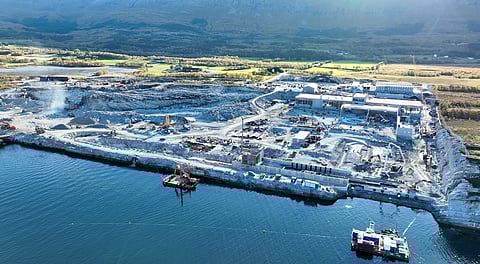


This is how the construction of Arctic Seafarm's land-based salmon farming facility was progressing in September 2025.
Photo: Arctic Seafarm.

Norwegian supplier of tailored IT solutions Nordlo announced it has entered into an agreement with Arctic Seafarm to deliver IT infrastructure and operations for the new land-based salmon farming facility in Nesna, in Helgeland, Nordland County, Norway, which the company is building together with its partners, Kvarøy Fiskeoppdrett and EMK Capital.
The facility, which will use a hybrid flow-through system, protecting the fish from sea lice, the external environment, and safeguarding them against escapes, combines modern salmon aquaculture technology with a data-driven approach.
"Production at the facility is largely data driven," Marius Mønsted, CEO of Nordlo Venneslam, explained. "Arctic Seafarm will measure and analyse parameters such as oxygen saturation, water temperature and other production data to optimise fish health and maximise output over time," he continued, noting that the data collected is also essential for meeting the requirements of the Norwegian Food Safety Authority (Mattilsynet).
"For us, it is crucial to work with suppliers who understand our operations and the requirements placed on us," said, for his part, Carsten Rimer, Chief Administration Officer at Arctic Seafarm. "Nordlo has the experience and expertise we need to build a stable and future-proof IT environment," he added.
As Nordlo highlighted in its release announcing the agreement, land-based salmon farming is a key growth area in Norway. Shifting production from the sea to land reduces challenges such as sea lice and emissions, although it also creates new needs such as data management.
In the case of Arctic Seafarm, the company is building a production environment that promotes fish health and has a low carbon footprint. To this end, as mentioned, it has opted for a flow-through system. Water is sourced externally, and wastewater is treated.
The goal is to combine natural conditions for salmon with improved control and reduced environmental impact, with the aim of producing up to 25,000 tonnes of salmon annually.
As the land-based salmon producer explained when launching the project in October 2024, in Phase 1, Arctic Seafarm plans to produce approximately 10,000 tons (8,000 tons HOG) and employ about 40 people. However, the 15,000 tons MAB (Maximum Allowable Biomass) grant will allow the production of up to those 25,000 tons of salmon in subsequent phases.
To achieve this, Nordlo will deliver network, wireless infrastructure, and end-user equipment. The company is also responsible for monitoring and operating the entire IT environment at the facility. The IT supplier said the installation is extensive, and final delivery is planned for the second quarter of 2026.
"In modern, land-based facilities, IT forms part of the backbone of production. Nordlo's role is to ensure stable operations, high security and access to the right data, enabling Arctic Seafarm to focus on its core business," CEO of Nordlo Vennesla Marius Mønsted stated.
"We have always prioritised quality. Nordlo is the best supplier we could have chosen," Chief Administration Officer at Arctic Seafarm Carsten Rimer added, for his part.
The agreement reached with Nordlo joins others that the company and its construction partners, Eyvi, Totalbetong, and Johs. J. Sylteren—which are responsible for delivering a turnkey facility—have been finalizing since last year as construction progresses.
The first announcement was the agreement reached between SIMONA Stadpipe and Eyvi to supply a complete piping package for the entire water distribution and fish transport system at the Arctic Seafarm facility. Next, we learned that the Swedish-Swiss multinational electrical engineering corporation ABB would be responsible for automating the system, and finally, it was announced that the water treatment system would be supplied by Norwegian Greentech.
