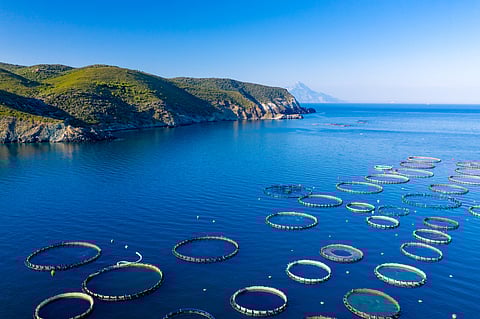


A sea bream aquaculture farm in Greece.
Photo: Adobe Stock.

Higher prices supported seabass and seabream export values in 2025, despite limited supply, combined with rising feed and labour costs, according to statistics released by FAO GLOBEFISH, the UN agency’s fisheries and aquaculture market analysis project.
The figures showed that demand for the two fish species, which are widely farmed across the Mediterranean, remained stable in the main European Union markets, while exporters increasingly benefited from higher prices despite flat or lower export volumes compared with the previous year.
Although Türkiye, the world's leading seabass producer, saw its export volume decline by about 25% year on year, the value of its exports increased by 5% overall, led by those to the UK, which rose by 34%.
Türkiye also recorded higher revenues in the United Arab Emirates, Kuwait and Lebanon, although its exports to Spain fell significantly, by 84% in volume and 79% in value compared with the previous year.
Meanwhile, Greek seabass exports remained broadly stable at 54,700 tonnes, while their value increased by 20% to USD 429.9 million. Italy remained the main destination for Greek seabass, with imports rising by 12% in volume and 33% in value, reaching 32,700 tonnes, worth USD 284.9 million.
Croatia also increased its seabass trade with Italy, with both import volume and value rising by more than 50%.
Greece remained the leading seabream exporter in 2025. Its exports increased by 4% to 66,030 tonnes, while their value rose by 20% to USD 492.8 million.
Meanwhile, Türkiye’s seabream export volume fell by 8%, but similarly to its seabass exports, the value nevertheless increased by 7%.
FAO GLOBEFISH said it expects tight supply and firm prices to continue supporting export values in 2026. However, it warned that high prices and rising logistics costs could restrict consumption growth in the main markets.
