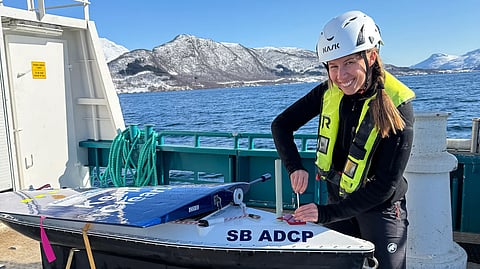


The sailing buoy is being prepared for deployment. It is powered by solar cells, controlled via the internet, and equipped with various measuring instruments.
Photo: Akvaplan-niva

Norway has strongly relied on environmental monitoring over the past decades to understand and predict the potential effects of climate change and local environmental impacts.
As highlighted by Akvaplan-niva in a recent article, standardized monitoring methods are used to collect high-quality environmental data, providing a fundamental source of knowledge for environmental assessment and management.
The Norwegian Environment Agency is responsible for several national environmental monitoring programmes covering both freshwater and marine ecosystems.
For example, the ØKOkyst program has been operating since the 1990s, collecting data on the environmental status of Norway's fjords and coastal waters, from the Oslo Fjord in the south to Varanger in the north.
Meanwhile, ØKOstor monitors 26 of Norway's largest lakes, while ØKOfersk assesses the condition of nearly 100 smaller freshwater bodies distributed across the country.
In the northern part of the country, where distances are much greater, Sail Buoys have been introduced. These unmanned vehicles are propelled by an electric motor powered by solar energy and, equipped with advanced sensors, can collect data over long distances without producing CO₂ emissions.
Finally, the traditional method par excellence is the use of binoculars, which are employed to map shallow waters and collect essential information on the distribution and health status of seagrass meadows.
All of this information is integrated into the central databases of the Norwegian Environment Agency, where it is made publicly available for anyone to access.
"National and international environmental monitoring programmes provide an essential source of information for understanding both the current state and the future development of the environment around us," says Akvaplan-niva's statement.
