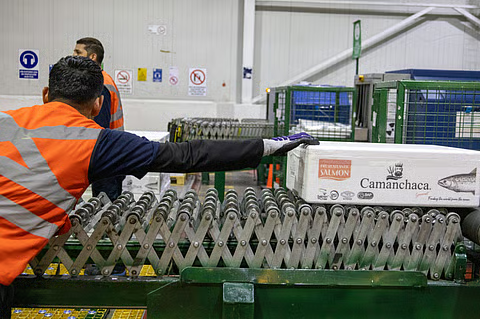


After a challenging start to the year for Camanchaca's Salmon business, the company projects a recovery in this division during Q2.
Photo: Camanchaca.

Camanchaca presented its consolidated financial results for Q1 2026 this week. With revenues 10% higher than the same quarter of the previous year—reaching USD 240 million—the company highlighted that this growth was driven by the increased revenue recorded across all three of its business lines: fishing, salmon, and mussels.
During the period, the Chilean seafood company's EBITDA reached USD 42 million, in line with the first quarter of last year, while the profit for the period reached USD 15.5 million, 24% higher than the previous year, continuing the upward trend established throughout fiscal year 2025, when Camanchaca's profit increased by 90%.
In its release on the results, the Chilean company explained that the revenue growth of the Fishing business in Q1 2026 was due to higher sales volumes from the beginning inventory of the year, as well as higher prices for fishmeal and frozen jack mackerel.
Both circumstances helped to mitigate the 29% drop in jack mackerel catches and the 49% drop in catches of all pelagic fish.
According to Camanchaca, the sharp drop in pelagic catches is due to higher ocean surface temperatures, both in the north and the south, which has reduced the availability of resources, although the biomass is in good condition, as noted by its General Manager, Ricardo García Holtz.
"This year, the fishing industry is going through a very complex situation due to the warmer ocean conditions, reducing the availability of fish, which has resulted in half the catches in these first months," he explained.
"But it is important to clarify that the jack mackerel resource is healthy and the problem has been its availability and not its condition, and history shows that this condition should be reversed in the near future," added García Holtz optimistically.
The seafood company also noted that this production impact, which, in addition to Chile, also affects Peru, has increased prices and allowed the sale of year-end inventories at a good margin, so that, in this first quarter, the Fishing Division contributed 72% of the group's EBITDA.
In the Salmon business, Camanchaca recorded higher harvests and sales that offset the price drop in international markets. Specifically, harvests increased by 3%, while, thanks to the use of initial inventories, sales rose by 16%, thus mitigating a 10% drop in the Atlantic salmon price.
However, as Salmones Camanchaca informed in its Q1 2026 results report, the Chilean seafood company's salmon division experienced a challenging start to the year. During the quarter, two farming sites were affected by SRS (Salmonid Rickettsial Septicemia) outbreaks, which resulted in extraordinary mortalities of USD 2.8 million, which affected their EBITDA, and forced the harvest to be brought forward.
As a result, the harvested salmon registered lower weights than desired; however, Camanchaca noted that, despite that lower weight, the quarterly ex-cage cost fell by 6% thanks to lower feed costs and operational efficiencies.
This operational efficiency, coupled with the fact that, as García Holtz explained in the results report of Salmones Camanchaca —of which he is Vice President—, globally no growth in supply is expected, demand is increasing, particularly in Asia, and the health situation has normalized, makes the executive optimistic about what is to come.
"Regarding the Salmon business, the start of the year was weak due to SRS outbreaks that worsened production indicators at two farms and because prices were weaker than we expected due to increased global supply," Camanchaca's General Manager said. "We project a recovery in this division during the second quarter with increased harvests and prices, as supply should decrease starting in the third quarter."
The Chilean seafood company's third line of business is mussels. In the first quarter of this year, mussel farming saw a significant improvement compared to last year, with an EBITDA of USD 1.8 million, double that of the same quarter in 2025. Camanchaca stated that both higher sales volumes and better prices were recorded for mussels.
It should be noted that during Q1 2026, the company launched a pilot project for maritime transport logistics for its Mussel business, intending to be more efficient in its operations and ensure a continuous supply of raw materials for its processing plant Camanchaca Cultivos Sur.
As Rafael Ortega, Regional Manager of Camanchaca Cultivos Sur, highlighted when the project was presented, this maritime logistics pilot program allows the company to operate more efficiently, minimizing risks and giving it better access to supplier farms, while also contributing to the safety of coastal communities during a period of high population density, such as summer.
Finally, to conclude his assessment about the first quarter, Ricardo García Holtz also referred to the current political situation in the country, after the Chilean National Congress approved by majority vote last week the announced 'National Reconstruction and Economic and Social Development Law'—better known as the "reconstruction bill" or "reconstruction plan"—promoted by the new government of José Antonio Kast.
"Institutionally, we are eagerly awaiting the outcome of the legal and regulatory changes that the current government is promoting for more efficient and sustainable growth in the industry, thus enabling the development of the southern regions. And because there doesn't seem to be any more harassment of industrial fishing," Camanchaca's General Manager stated.
García Holtz's mention of southern Chile is no coincidence. This area is where most of the country's aquaculture activity, and more specifically salmon farming, takes place. Thus, although the reconstruction bill still needs to pass the Senate to become law, the Chilean salmon industry has already expressed its support through the SalmonChile association, of which Camanchaca is a member.
"It is undoubtedly a positive step and one that goes in the right direction to boost the country's growth, recover jobs, and generate the certainty required for long-term investment," the President of the trade association, Patricio Melero, said.
