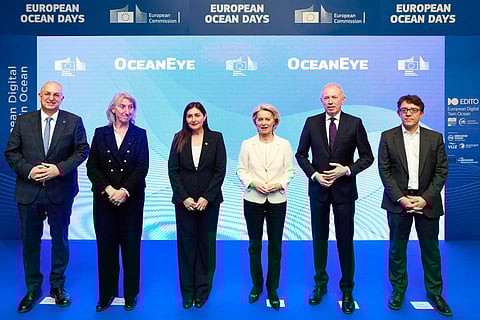


European Commission President Ursula von der Leyen, pictured with EU Fisheries Commissioner Costas Kadis and other officials at the launch of OceanEye on Monday.
Photo: European Commission

A new European ocean observation initiative aimed at strengthening marine data collection and protection has been launched this week by the European Commission, alongside a call for an international alliance to support global monitoring systems.
Speaking at opening of the European Ocean Days yesterday, Commission President Ursula von der Leyen announced the creation of OceanEye and a €50m contribution from the EU’s Horizon Europe programme for 2026-27 to support a new "International Alliance".
“Today, we have presented OceanEye, a major initiative to strengthen the EU's leadership in ocean observation and unlock the full potential of our ocean," von der Leyen said.
“We will advance scientific knowledge, boost the blue economy's competitiveness, enhance maritime security, and crucially protect the ocean's health. Together with international partners, we will reinforce a sustainable and resilient Global Ocean Observing System,” she added.
The Commission said OceanEye will build on existing tools, including the European Digital Twin of the Ocean and the EU’s Copernicus Marine Service, to create what it describes as a more sovereign and technologically advanced observation infrastructure. The aim is to improve access to reliable marine data, support economic activity at sea and contribute to climate resilience and maritime security.
Von der Leyen argued that comprehensive ocean monitoring should be treated as essential infrastructure rather than a patchwork of voluntary cooperation. “The marine data network must be recognised as vital planetary infrastructure,” she said, adding that more predictable, long-term funding would be required.
She cited examples such as flood protection systems and early warnings for algal blooms affecting shellfish farmers to illustrate how real-time data can protect both communities and livelihoods. But she acknowledged that monitoring coverage remains uneven, with gaps in coverage of European waters and increasing pressure on the global monitoring network.
“We need more funding. And with OceanEye, we want to turn the tide. We want to close the gaps and enlarge the global network further so that OceanEye will lead a new charge for truly global observation surge,” she said.
The proposed International Alliance is to bring together EU member states, partner countries, private actors and philanthropies to secure financing and coordinate action. According to the Commission, it will support the capacities of the Global Ocean Observing System, in partnership with UNESCO’s Intergovernmental Oceanographic Commission.
OceanEye forms part of the European Ocean Pact adopted in 2025. The European Commission has set an objective of having a fully operational European Ocean Observation System in place by 2030, with a pledging event for the alliance planned for September and further legislative steps expected later this year.
EU Commissioner for Fisheries and Oceans, Costas Kadis predicted OceanEye "will be a game-changer for the EU's ocean observation capabilities", and suggested a range of benefits, including economic effects.
"By integrating marine knowledge services, developing a European market for Ocean Observation technologies, and fostering international cooperation, we will create new opportunities for sustainable growth and job creation in the blue economy," he argued.
