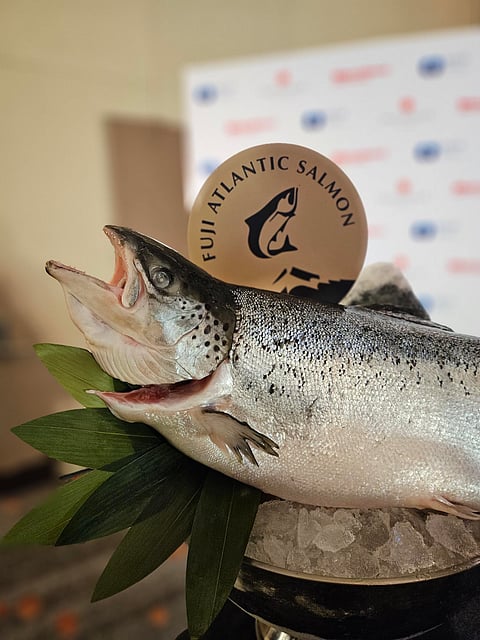


"Market response has been encouraging and demand for Fuji Atlantic Salmon remains strong," Proximar said.
Photo: Proximar Seafood.

After closing Q3 2025 on track to reach its year-end biomass target of 2,000 tons, last Friday, Proximar Seafood reported its fourth quarter and preliminary full year 2025 results, having almost reached it and, therefore, looking further.
"The company ended the year with close to 2,000 tons in standing biomass, providing a solid foundation for improved harvest weights and price achievement through 2026," the statement to the stock exchange read.
Japan's first large-scale salmon farm said that, as its operational update last January indicated, the quarter showed continued operational improvement with stable biology, normalized feeding and steady growth throughout the facility.
Furthermore, it also noted that, after the use of AI-powered fish cameras began in December, which allow for verification of standing biomass and monitoring of growth performance, biological control has improved significantly, showing solid improvements.
"Our performance throughout 2025 is a testament to the work of our team and their determination. In the fourth quarter, we continued our good operational development, and we reached our targeted biomass level by year‑end," said CEO Joachim Nielsen.
The CEO of Proximar Seafood was thus referring to the prolonged period of lower average harvest sizes and, consequently, lower prices achieved, recorded by the company throughout last year, mainly due to reduced feeding following incidents with the biofilter in the fourth quarter of 2024.
Thus, after this continuous operational improvement, Proximar's standing biomass at the end of the year was 1,949 tons, compared to 1,389 tons recorded at the end of Q3, that is, 40.31% (560 tons) more than in the previous quarter, with a survival rate of 99.7% in the growth phase.
Regarding the total harvest, according to data reported by Proximar Seafood, it reached 339 tons of head-on gutted (HOG) salmon in the quarter. Furthermore, the Norwegian land-based salmon producer stated that the average harvest weight was approximately 2.1 kg HOG, with over 98% being of superior grade, resulting in an average net sales price of approximately NOK 65 per kg in the quarter.
Throughout 2025, the company harvested fish weekly and supplied a total of 1,338 tons of fresh Fuji Atlantic Salmon—its trademark—to the market in Japan. "Market response has been encouraging and demand for Fuji Atlantic Salmon remains strong," Proximar claimed in its release.
The company also noted that, for commercial-sized fish weighing more than 3 kg HOG harvested at its RAS facility near Mount Fuji in Q4 2025, the average price achieved was NOK 112/kg net, confirming what, in the previous quarter, the company described as "the significant advantage of local production in Japan."
"Price achievement for fish above 3 kg HOG has remained solid throughout the year, confirming the significant cost advantage of local production in Japan. Demand remains strong, confirming the advantages of proximity, freshness, and predictable supply," Proximar stated now.
Regarding the forecasts for the year that has just begun, Proximar said that, in the first quarter of 2026, it is harvesting the remaining fish affected by previous production disruptions, so the average harvest weight for the period is expected to be around 2.4 kg HOG.
However, starting in the second quarter, it expects harvest weights to normalize and increase to an average of 3.5–3.8 kg HOG for the remainder of the year, which, Proximar claimed, will result in better price achievement. The company expects the full-year harvest to reach between 3,500–4,000 tons HOG.
"We enter 2026 with full production capacity, stable operations and strong customer demand. As volumes increase and harvest weights normalize from the second quarter, we expect to see a significantly improved price achievement and a more predictable performance," CEO Joachim Nielsen stated.
In its release, Proximar Seafood also said that lower average harvest weights will temporarily affect cash flow, so the company is in the process of working with banks to secure additional short-term credit lines.
Likewise, it also reported that it has proactively requested a covenant waiver related to the revised harvest plan and continues to receive strong support from its lenders.
On the financial side, according to data provided by Proximar, at the end of the year, the equity ratio improved to 28.6% from 24.2% the previous year, reflecting a stronger balance sheet, following a successful refinancing that reduced total debt by NOK 173 million.
It should also be noted that former Board Chair Kjell-Erik Østdahl stepped down from his position effective from 1 January 2026. Board member Viggo Halseth, who has been a board member since 2022 and has 38 years of experience in the aquaculture feed industry, took over as interim Chair until the next general meeting.
The announcement of his resignation came shortly after another announcement, also during Q4, in which Tetsuya Kobayashi was appointed as the new Chief Financial Officer.
With this appointment, the company continued what it describesas "a gradual and planned organisational shift of resources from Norway to Japan." The outgoing CFO, Ole Christian Willumsen, whose departure was scheduled for the end of January, was Proximar's only remaining employee in Norway.
