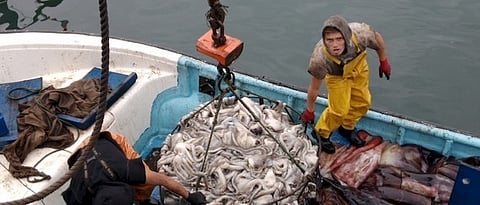


"When a country depends exclusively on the international price of a resource, fishing families become extremely vulnerable to external crises," said Chile's Undersecretary of Fisheries and Aquaculture.
Photo: Subpesca.

During Q1 2026, Chilean cuttlefish exports registered a drop of over 84% in value compared to the same period in 2025, while the average price decreased by approximately 48%, directly impacting the income of artisanal fishers and processing plants. In response, instead of approaching the issue primarily from a regulatory standpoint—as is the case in the salmon farming sector, for example—Chile's Undersecretariat of Fisheries and Aquaculture (Subpesca) raised the need to develop a national strategy to generate greater added value for this resource and avoid future cuttlefish industry crises.
Although it is mainly concentrated in the center of the country, between the Coquimbo and Biobío regions, the Chilean cuttlefish fishery extends along the country's entire coast, from the Arica and Parinacota region in the far north to the Magallanes region in the far south.
In addition to the vast potential fishing grounds—Chile has a coastline of approximately 4,300 kms in a straight line—the total catch quota is projected to reach 200,000 tons by 2026, with the resource remaining available and no signs of biological degradation. Therefore, the crisis facing the sector this year is not a situational problem, but something that goes beyond the availability of the resource.
As explained by the Chilean Undersecretary of Fisheries and Aquaculture, Osvaldo Urrutia, the current situation is mainly due to a significant drop in international prices for the resource, a phenomenon associated with the increased supply of competing products from other countries, such as Peru and Argentina, but also with difficulties in the commercialization chain.
Another piece of data on Q1 2026 provided by Subpesca indicates that the Chilean cuttlefish industry showed a decrease in its activity, going from 64 operational processing plants in 2025 to 55 during this year, along with a reduction of nearly 35% in production.
"Today, we are facing an economic crisis stemming from international market conditions, not from a lack of resources or internal regulatory changes. Therefore, Chile's challenge cannot be limited solely to extracting and exporting raw materials; we must decisively move towards a value-added strategy for Chilean cuttlefish," said Osvaldo Urrutia.
"When a country depends exclusively on the international price of a resource, fishing families become extremely vulnerable to external crises. We need to strengthen the production chain, develop new products, open markets, and generate greater stability for fishing communities and workers," Chile’s Undersecretary of Fisheries and Aquaculture continued.
Thus, faced with this scenario and with the aim of strengthening the sector's economy in the face of international crises and market fluctuations, Subpesca emphasized that the focus should be on strengthening the sector's competitiveness through innovation, productive diversification and new commercial alternatives, avoiding shifting a temporary economic crisis towards an exclusively regulatory debate.
"The future of artisanal fishing also depends on incorporating development, innovation, and new economic opportunities for coastal communities. Chile has the potential to transform cuttlefish into a higher value-added product, generating employment, regional growth, and greater social stability for thousands of families," Urrutia concluded.
