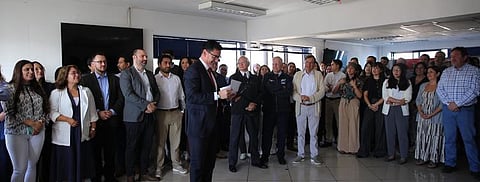


On his first day in office, Osvaldo Urrutia met with the technical teams of the Chilean Undersecretariat of Fisheries and Aquaculture in the central offices in Valparaíso.
Photo: Subpesca.

This Wednesday, March 11, the same day that the new Chilean President, José Antonio Kast, took office, so did the new Undersecretary of Fisheries and Aquaculture of Chile, Osvaldo Urrutia Silva, emphasizing that he does so "with a technical foundation as a basis."
In a cabinet marked by independent names, rather than political affiliations, the new head of Chile's Undersecretariat of Fisheries and Aquaculture (Subpesca)—an agency that, in turn, reports to the Ministry of Economy, Development and Tourism, whose new head is Daniel Mas, who also leads the Ministry of Mining—has a solid international academic background, in addition to a career of more than 20 years linked to the public sector and international organizations related to fisheries and aquaculture.
The new Undersecretary has also distinguished himself through his work in academia. In fact, until his appointment, he served as a professor of Public International Law and the Law of the Sea at the Pontifical Catholic University of Valparaíso.
According to the note issued by the Chilean Undersecretariat of Fisheries and Aquaculture, its new leader is a lawyer from the Pontifical Catholic University of Valparaíso (PUCV) and holds a doctorate in Law from Victoria University of Wellington, in New Zealand (2022), in addition to a master's degree in International Law from University College London (2008).
Regarding his professional career, the Subpesca statement said that Urrutia has developed a career of more than 20 years linked to the public sector and international organizations, highlighting his work as a consultant in the Fisheries and Aquaculture Division of the FAO and his work in the Legal Division and the International Affairs Unit of the Chilean Undersecretariat of Fisheries and Aquaculture itself between 2009 and 2022.
On his first day in office, the new Undersecretary met with the technical teams of the Undersecretariat and outlined the key principles of his leadership for the four-year period, 2026-2030, which is now beginning. Urrutia noted that his administration will focus on strengthening management based on scientific evidence, strict adherence to current regulations, and dialogue with all stakeholders in the fisheries and aquaculture sector.
Osvaldo Urrutia emphasized that, with a technical foundation, the institutional framework must provide conditions for the economic development of the sector, promoting the growth of fishing and aquaculture activities within a framework of clear rules, sustainability, and competitiveness.
Likewise, he also pointed out that the Undersecretariat of Fisheries and Aquaculture is a state institution that operates according to established technical mechanisms, which must translate into specific conditions for the sector to generate value, investment, and employment.
"Our challenge, in the Government of President José Antonio Kast, is to consolidate a governance that combines sustainability, regulatory certainty and public trust, putting fishing and aquaculture activity at the service of the country's growth," concluded the new head of Subpesca.
With those statements, Urrutia seemed to be responding to the demands made a few days earlier by the new President of SalmonChile, Patricio Melero, who, a few days before, in taking up his new role, used his first speech to, among other things, ask the new Chilean government "a long-term vision" for the development of southern Chile, where the bulk of the sector is concentrated.
"We expect leadership, clear rules, and a long-term vision for the development of southern Chile," he said. "We need regulatory clarity, legal certainty, and an agenda that not only enables but also drives investment, innovation, and the adoption of new technologies. Without certainty, there is no investment, and without investment, there is no development," Melero added.
A few days earlier, Ricardo García Holtz, Vice President of Salmones Camanchaca, had spoken in a similar vein. "We hope that the newly elected authorities will break the deadlock that has hindered the development of the industry for many years, because Chile has great unused advantages that would contribute to more growth, more jobs, more taxes paid, and more vitality for the south and for Chile in general," he stated.
