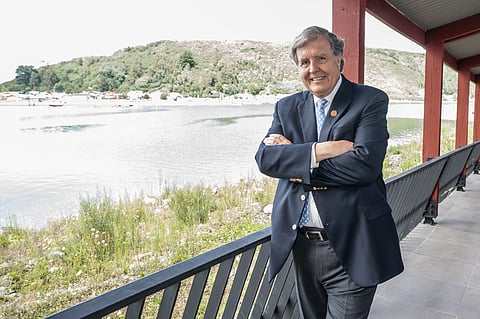


Patricio Melero, the new President of SalmonChile, at the Empormontt City-Port Linkage Center in Puerto Montt, where the ceremony took place.
Photo: SalmonChile.

As announced at the time of his election in late January, the new President of SalmonChile, Patricio Melero, has taken up his new role with the arrival of March. In a ceremony that the trade association described as "unprecedented" in its 40-year history, the new face of the Chilean salmon industry used his speech to, among other things, ask the incoming Chilean government for "a long-term vision" for the development of southern Chile, where the bulk of the sector is concentrated.
An agricultural engineer with knowledge of the Chilean aquaculture sector, Melero is also a former congressman and former Minister of Labor and Social Security, who brings extensive experience in public policy to the position. During his parliamentary career, he served on and chaired the Lower House's Fisheries and Aquaculture Committee for five terms, notably contributing to the passage of the first Fisheries and Aquaculture Act in 1991, which incorporated the development of aquaculture and the sustainable use of marine resources.
The new President of SalmonChile took over from Arturo Clément. After eight years leading the association—a period marked by significant challenges and progress for the sector—in his farewell address, the outgoing President emphasized the importance of trust among all stakeholders involved in salmon farming.
"We deeply understood that growth without legitimacy is unfeasible and that trust is not inherited; it is built. We concluded that transparency and dialogue were the only way to operate. We asserted ourselves and deployed where it really mattered: in the territories, with our workers, with the suppliers, with the authorities and with the citizens, working side by side to build an industry that represents us all," Clément emphasized.
His successor, for his part, reaffirmed SalmonChile's commitment to continue working for the country, pointing out that he looks forward to the support of the incoming government, which will take office on March 11.
"We expect leadership, clear rules, and a long-term vision for the development of southern Chile," said the new industry leader, Patricio Melero. "We need regulatory clarity, legal certainty, and an agenda that not only enables but also drives investment, innovation, and the adoption of new technologies. Without certainty, there is no investment, and without investment, there is no development."
Held in Puerto Montt, in the Los Lagos region, historically the center of the salmon industry in Chile, the event was attended by regional and municipal authorities—such as the governor of Los Lagos, Alejandro Santana, and the mayors of Puerto Montt, Rodrigo Wainraihgt; Puerto Varas, Tomás Gárate; and Calbuco, Marco Silva, union representatives, artisanal fishing leaders, leaders of other unions and prominent businessmen from the productive sector.
Among the more than 200 attendees were also leaders from the salmon industry, such as José Ramón Gutiérrez, president of Multi X; Rodrigo Sarquis, president of Blumar; and Andrés Santa Cruz, director of Blumar and former president of the CPC; the general manager of Marine Farm, Roberto Riethmüller; the manager of the salmon division of Camanchaca, Manuel Arriagada; and the director of SalmonChile and founder of Compas Marine, Jorge Pacheco, among others.
The inauguration ceremony was also attended by a large representation from the labor world, including leaders from the Multisindical de Trabajadores Salmoneros (Salmon Workers' Union) and the Coordinadora Nacional de Trabajadores de la Industria del Salmón (National Coordinating Committee of Salmon Industry Workers).
Some of those in attendance, such as the president of Multi X, also spoke. "We are the country's second most exported product, representing more than 2% of the national GDP, generating over 86,000 jobs, and connecting thousands of supplier companies from Biobío to Magallanes," highlighted José Ramón Gutiérrez. "This is real decentralization, applied innovation, productive integration, and social mobility for thousands of families in southern Chile," he concluded.
Along the same lines, Rodrigo Wainraight, mayor of Puerto Montt, the "salmon capital" of Chile, emphasized the sector's economic impact. "When you see that the industry contributes 40,000 direct and 40,000 indirect jobs, when it contributes USD 1.6 billion to SMEs, and exports between USD 6 billion and USD 7 billion, well, those are specific contributions that today make Puerto Montt, a region, and a country bigger. These are things that need to be nurtured and strengthened," he said.
The governor of the Los Lagos Region, Alejandro Santana, highlighted the importance of salmon farming in coastal areas. "I know how important it has been, not only for those who work in it, but also for suppliers and vendors in this industry that has developed and grown. And on the other hand, given the competitive nature of the industry, one of my biggest concerns is how to ensure we don't lose our competitive edge," he stated.
Finally, during the ceremony, the invitation was also extended for the 'Salmon Summit 2026', which, as reported by WeAreAquaculture, will be held this year in May, within the framework of the celebrations of the 40th anniversary of SalmonChile, and will focus precisely on analyzing different topics related to the potential of salmon farming and relevant to the development of the southern zone of the country.
