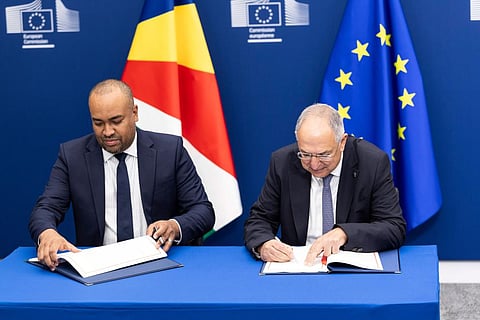


On 27 July 2026, in Brussels, Belgium, Wallace Cosgrow, Minister for Fisheries, Agriculture and Blue Economy of Seychelles, and Costas Kadis, European Commissioner for Fisheries and Oceans, sign a Sustainable Fisheries Partnership Agreement.
Photo: European Commission

The European Union and Seychelles have signed a new four-year fisheries protocol allowing EU vessels to catch up to 55,000 tonnes of tuna and other migratory species annually in Seychelles’ waters.
The protocol was signed in Brussels on 27 July by EU Commissioner for Fisheries and Oceans Costas Kadis and Seychelles’ Minister for Fisheries, Agriculture and Blue Economy, Wallace Cosgrow.
Up to 30 EU purse seiners and eight longliners will be eligible to apply for licences under the agreement. Fishing operations had been suspended since the previous protocol expired on 23 February 2026.
The deal will see the EU contribute €23 million over the four-year period. Of this, €3 million is allocated to supporting the development of Seychelles’ fisheries sector, including small-scale fisheries and aquaculture, scientific cooperation, sanitary and quality management, and measures to combat illegal, unreported and unregulated fishing.
EU vessel operators will also pay Seychelles a licence and catch fee of €90 per tonne, alongside a separate contribution for environmental management and the monitoring of marine ecosystems.
According to the European Commission, the agreement aims to help supply the EU tuna market while reducing dependence on imported fishery products.
Tuna was the EU’s most consumed aquatic product in 2023, at an average of 2.68 kg per person, and represented 11% of the bloc’s fishery and aquaculture product imports by volume in 2024.
Both parties participate in the Indian Ocean Tuna Commission, which manages tuna and tuna-like species in the region. The protocol also includes provisions covering employment and working conditions on EU vessels, referring to standards established by the International Labour Organization and the International Maritime Organization.
“Today’s renewed partnership with Seychelles shows what the EU stands for: trusted cooperation, sustainable fisheries and a stronger economy. The renewal of our partnership is positive for our fishers, for Seychelles, and for the long-term health of our shared ocean,” Kadis said.
The protocol has applied provisionally since 27 July, and will formally enter into force once both parties complete their ratification procedures, including obtaining the consent of the European Parliament.
