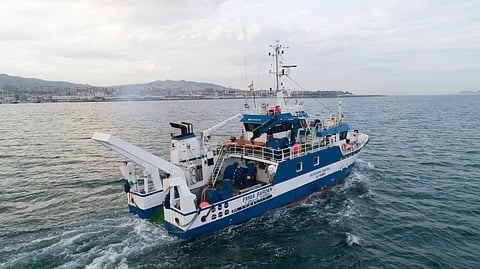


The Spanish fisheries and oceanographic research vessel Emma Bardán will map the seabed before and after trawling with both types of door.
Photo: Secretaría General de Pesca / Government of Spain.

Researchers have begun a field trial off the coast of Alicante, Spain, to assess whether semi-pelagic trawl doors can reduce the effects of bottom trawling on the seabed without undermining commercial fishing performance.
The project will compare semi-pelagic doors, sometimes called "flying" doors, with conventional trawl doors. Semi-pelagic models are designed to operate slightly above the seabed, potentially reducing direct contact and sediment disturbance while maintaining the horizontal opening and stability of the trawl gear.
The trial is being conducted by Spain’s General Secretariat for Fisheries and the General Fisheries Commission for the Mediterranean (GFCM), part of the Food and Agriculture Organization of the United Nations. The Spanish Institute of Oceanography, IEO-CSIC, is leading the fieldwork.
Researchers are using the same commercial bottom trawl vessel for both stages of the study. The vessel will first fish with semi-pelagic doors and then with conventional doors in the same fishing grounds and in immediate succession.
According to the project partners, this approach should limit the influence of differences between vessels, seasons, locations and environmental conditions, allowing a more direct comparison of the two configurations.
The study is relevant to Mediterranean fisheries targeting species including deep-water rose shrimp, European hake, red mullet, blue and red shrimp, Atlantic horse mackerel, mantis shrimp and common pandora.
“During the fishing operations, researchers will assess catch rates, catch composition, gear geometry, trawl door behaviour and operational efficiency. The objective is to determine whether semi-pelagic doors can reduce environmental impacts without compromising fishing performance or the practicality of day-to-day commercial operations,” said Sergi Tudela, fishery officer and coordinator of the GFCM Western Mediterranean Technical Unit.
The Spanish fisheries and oceanographic research vessel Emma Bardán will map the seabed before and after trawling with both types of door. The vessel will also monitor water clarity during fishing operations to measure the amount of sediment disturbed by each configuration.
The trial forms part of the GFCM’s MedSea4Fish programme and supports the organisation’s 2030 Strategy. Its findings are expected to provide evidence for future decisions on the use of lower-impact fishing gear in Mediterranean bottom trawl fisheries.
The trial follows the inclusion of semi-pelagic doors among the measures available to Mediterranean trawlers under the EU’s fishing-effort compensation scheme for 2025.
Spain’s fleet was initially allocated 27 fishing days, but the EU AgriFish council eventually reached a deal stipulating that vessels could recover additional days through measures such as using nets with selective mesh sizes and installing flying doors.
The Spanish government also provided financial support to help vessels install the new equipment. According to the government, the compensatory measures allowed the fleet to operate for around 130 fishing days in 2025, with 192 Spanish trawlers adopting semi-pelagic doors.
For 2026, EU fisheries ministers agreed an allocation of 143 fishing days for Spain’s Mediterranean trawl fleet, without requiring vessels to apply the compensatory measures used during the previous year.
Mediterranean fishing countries Spain, France and Italy have already said they will be once again be forming a strategic alliance to negotiate the fishing days for 2027, in addition to calling for reforms to the EU's regulation on fishing in the Western Mediterranean.
