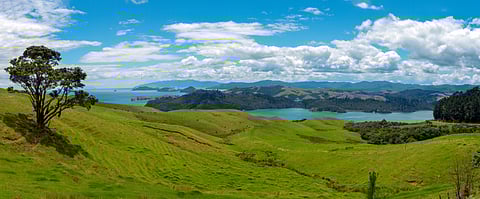


Panoramic view of the Hauraki Gulf (Tikapa Moana), North Island, New Zealand.
Photo: Adobe Stock.

New Zealand's Oceans and Fisheries Ministry announced that the temporary ban on harvesting certain types of shellfish in parts of Hauraki Gulf, ordered in 2024, has been extended for another two years. The closures again affect the areas of Waiheke Island, Umupuia Beach near the Duder Regional Park, and the coastline of Te Mātā and Waipatukahu.
"Extending these temporary closures is a practical step to help replenish local shellfish for the benefit of current and future generations," said New Zealand's Oceans and Fisheries Minister, Shane Jones, commenting on the measure.
As then, the decision has now also been made following the request of three different iwi (tribes) concerned about the long-term sustainability of some prized species in their coastal and marine areas. Specifically, they are Ngāi Tai Ki Tamaki, Ngāti Tamaterā Treaty Settlement Trust, and Ngāti Pāoa Iwi Trust.
In its release, the Ministry highlighted that all applicants are members of the Pou Rāhui Research Project, which combines the mātauranga Māori—the traditional knowledge system, accumulated wisdom and worldview of the indigenous Māori people of New Zealand—with modern scientific tools to restore identified marine taonga (treasured/highly valued) species within the areas.
"The group's work involves training whānau (family/extended family) in traditional skills and data collection to strengthen mātauranga, to support evidence-based decision-making, and to ensure the long-term sustainability of customary fisheries," New Zealand's Oceans and Fisheries Minister continued.
"I commend Ngāi Tai Ki Tamaki, Ngāti Tamaterā Treaty Settlement Trust, and Ngāti Pāoa Iwi Trust and the Pou Rahui Project for their strong kaitiakitanga (stewardship) in caring for these important local fisheries and the broader Hauraki Gulf," Shane Jones concluded.
When, back in 2024, the New Zealand Ministry of Oceans and Fisheries opened a public consultation on the decision regarding possible temporary fishing closures in the Hauraki Gulf—which were later ratified—Director of Fisheries Management Emma Taylor stated that the NZ Government supports traditional customary fisheries management such as rāhui and considers a variety of viewpoints along with the best available science and information.
"This includes information we receive from tangata whenua (people of the land/indigenous Māori people) and people who have valuable insights about what's going on in their fisheries — it's local knowledge from people who know their fishery well," she stated at the time.
As WeAreAquaculture then reported, in Māori culture, a rāhui is a form of tapu (spiritual restriction) restricting access to, or use of, an area or resource by the kaitiakitanga of the area. Following the passing of the 1996 Fisheries Act, a rāhui was able to be imposed by the New Zealand Ministry of Fisheries.
Thus, at the request of the three tribes mentioned above—Ngāi Tai Ki Tamaki, Ngāti Tamaterā Treaty Settlement Trust, and Ngāti Pāoa Iwi Trust—the rāhui imposed two years ago has now been renewed by NZ's Oceans and Fisheries Ministry.
In effect since August 7, the extended temporary closures affect the following areas and shellfish species:
Waiheke Island—whose ban includes waters within one nautical mile of Waiheke Island but excludes Te Matuku Marine Reserve—is closed to the harvesting of mussels, pāua (large edible NZ sea snails also known as sea ear), and packhorse rock lobster.
Umupuia Beach—whose closure covers waters from Te Puea at the western end of the beach to Whakakaiwhara Point at the eastern end of the beach—is closed to the take of cockles.
Te Mātā and Waipatukahu—whose ban covers waters from Ōtaki Creek to Diehard Stream (also known as Onepoto Stream), and offshore to one nautical mile—is closed to the take of cockles, mussels, oysters, and pipi (an edible saltwater clam).
