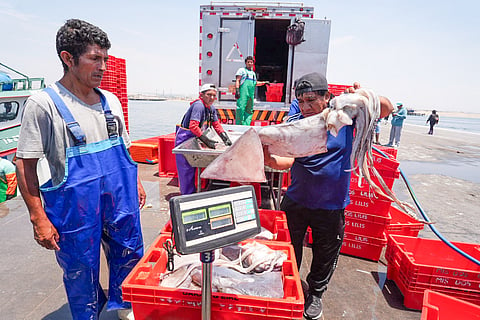


Artisanal fishermen landing jumbo flying squid at a port in Peru.
Photo: Produce.

Following the scientific advice of the Peruvian Institute of the Sea (Imarpe), Peru's Ministry of Production (Produce) announced this week the increase in the quota of the jumbo flying squid (Dosidicus gigas) to give continuity to the fishery during the second half of the year.
The measure was taken after cumulative catches reached 95.44% of the current limit, previously set at 539,230 tons. The Ministry of Production has added another 50,000 tons to that quota, raising the new total allowable catch (TAC) to 589,230 tons, representing an increase of 9.27%.
Jumbo flying squid is a strategic fishery for Peru both in terms of exports—90% of the catch is destined for export—and internally, since, as Produce recalled in its announcement, it is key for thousands of families who depend on this activity, and for the country's internal direct human consumption.
"This decision reaffirms the Government's commitment to science-based fisheries management. Every measure adopted by Produce responds to technical evidence from Imarpe and seeks to ensure that the use of our hydrobiological resources continues to generate employment and development, while contributing to their sustainability for future generations," stated the Peruvian Vice Minister of Fisheries and Aquaculture, Jesús Barrientos.
The Peruvian Ministry of Production emphasized that this new jumbo flying squid TAC is a fundamental tool for the sustainable management of the fishery, as it allows for the regulation of fishing effort, the permanent monitoring of catch levels, and the assurance that the exploitation of the resource remains within limits compatible with its natural renewal capacity.
Implemented under an adaptive management approach, with monitoring of catch trends and available scientific information on the resource, the measure reaffirms Produce's commitment to fisheries management that promotes the sustainability of resources while contributing to the economic and social development of thousands of families linked to artisanal fishing and its value chain.
In addition to setting a new TAC, the resolution also updates the management measures applicable to artisanal fishing vessels with less than 10 m3 of hold capacity, establishing a specific management scheme for this segment of the fleet.
Thus, Produce has established a catch limit of 98,411 tons, counted as part of the total TAC. Of this amount, 12,800 tons correspond to the period between July 6 and December 31, 2026, which, according to the Ministry, will strengthen the monitoring of catches and improve the control of the fishing effort.
"Fisheries management means responsibly managing our resources. With clear rules, defined quotas, and differentiated measures for each segment of the fleet, we strengthen control of fishing activity, provide greater predictability for fishermen, and ensure that jumbo squid continues to be harvested sustainably," said Vice Minister Barrientos.
In an effort to optimize competitiveness and increase controlled landings without affecting the sustainability of the resource, earlier this year, in January, Peru's Ministry of Production had already adopted measures to favor the artisanal fleet that fishes for jumbo flying squid, rewarding those vessels equipped with the government-backed Satellite Tracking System (SISESAT).
A few days before that announcement, Peru had reinforced its conservation and management measures for the jumbo flying squid fishery on the high seas to ensure its traceability in accordance with international standards. This reinforcement was aimed at ensuring that Peruvian vessels registered with the South Pacific Regional Fisheries Management Organization (SPRFMO) comply with international provisions to guarantee the sustainability and legality of the catches.
This approach to fisheries management is bringing the South American country ever closer to joining the Organisation for Economic Co-operation and Development (OECD), to the point that, in a document declassified in March, the organization described Peru's fisheries management—based on scientific research and analysis—as "world-class."
