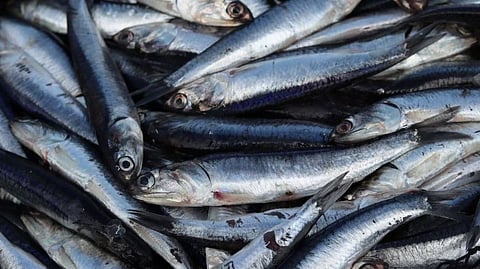


The anchovy quota was set following scientific advice from the Peruvian Institute of the Sea, which showed a healthy biomass.
Photo: Produce.

The first anchovy fishing season of 2026 in southern Peru is now underway. A few days before the end of 2025, Peru's Ministry of Production (Produce) announced that it had authorized its start and set the total allowable catch (TAC) at 251,000 tons.
The quota for anchovy (Engraulis ringens) and white anchovy (Anchoa nasus) resources, both intended for indirect human consumption—that is, for the manufacture of fishmeal and fish oil—was set following scientific advice from the Peruvian Institute of the Sea (Imarpe), which showed a healthy biomass.
"This season's authorization is based strictly on scientific criteria and a sustainability approach that allows us to take advantage of anchovy, ensure its future availability, and provide predictability to fishing activity in the south of the country," said the Peruvian Vice Minister of Fisheries and Aquaculture, Jesús Barrientos, who pointed out that this decision responds to responsible resource management.
The rule established for this first anchovy fishing season 2026 in southern Peru stipulates that only vessels with a valid fishing permit and a maximum catch limit per vessel assigned for the southern zone—which will be published by Produce—may operate.
Likewise, Peru's Ministry of Production reiterated that the use of purse seine nets with the minimum regulatory mesh size is required, as well as the performance of fishing activities outside areas reserved for artisanal and small-scale fishing, and the permanent operation of the Satellite Monitoring System (SISESAT) as a control and surveillance tool.
According to Produce's announcement, the season will run from January 1 to June 30, 2026, or until the authorized catch limit of 251,000 tons is reached.
If we take as a reference the still ongoing second fishing season of 2025 in the north-central zone, which, five weeks after its launch, had already reached over 72% of the authorized quota, likely, the first season of 2026 in the southern zone will not extend to the end of the authorized period either.
Finally, reaffirming its commitment to fisheries management that allows for the sustainable and responsible use of resources and conservation of the environment, but also the socio-economic development of the sector, Produce also established operating standards for the processing plants that will transform the anchovy.
Firstly, Peru's Ministry of Production reiterated that these processing plants must have a valid operating license and strictly comply with the Surveillance and Control Program, which prohibits the receipt of resources from unauthorized vessels, artisanal vessels or those without an assigned quota.
Similarly, in the event of operational failures, environmental accidents, or the excessive presence of species intended for direct human consumption, Produce regulation for processing plants stipulates the immediate suspension of raw material reception.
Both the anchovy fishing and its processing for indirect human consumption are key to Peru and the global feed industry, as the South American country has historically accounted for an average of 20% of global production of fishmeal and fish oil.
