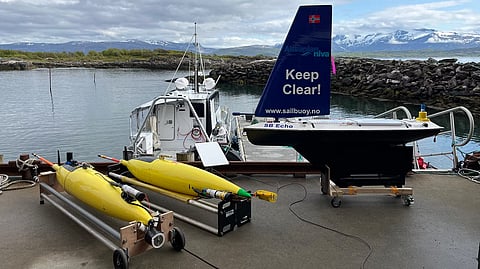


The Sailbuoy rigged with an echo sounder, and two Seagliders rigged with an optical imagery plankton sensor (UVP6) and an echo sounder.
Photo: Pierre Priou/Akvaplan-niva

The ocean research and consultancy Akvaplan-niva is leading a project to monitor and predict populations of Calanus finmarchicus, with the aim of turning this species into a sustainable source of fish feed.
Calanus finmarchicus is a crustacean abundant in the Norwegian Sea and rich in lipids. The Norwegian Institute of Marine Research estimates that current harvesting is about 0.5% of the annual quota and represents only 0.00004% of the estimated population.
"With the expansion of aquaculture, the potential for growth in the Calanus fishery is significant. This calls for proper management of this valuable marine resource to ensure sustainable exploitation," Akvaplan-niva said in a statement.
For this reason, the European Union's Sustainable Blue Economy Partnership decided to fund the CliN-BluFeed project to promote the Calanus fishery in the Norwegian Sea as a sustainable and climate-neutral blue resource for aquaculture.
The project also involves the Institute of Oceanology of the Polish Academy of Sciences (Poland), the Atlantic International Research Centre (Portugal), Cyprus Subsea Consulting and Services (Cyprus), and the Alfred Wegener Institute (Germany).
The CliN-BluFeed project uses advanced, low-carbon autonomous marine monitoring technologies, combined with remote sensing, artificial intelligence (AI), simulation modeling, and experimental research.
As early as 2024, the Research Council of Norway funded the Migratory Crossroad project, during which autonomous uncrewed vehicles (AUVs) equipped with advanced sensors were deployed from a research vessel.
In 2025, the team showed that these AUVs could be deployed and recovered directly from the shore, without the need for a research vessel. Also, it collected data over the course of a month, while the team gathered satellite images. Finally, laboratory experiments were conducted to study copepod behavior.
All this research has made it possible to develop a copepod population model that can predict its presence and density over time and across different areas of the ocean.
