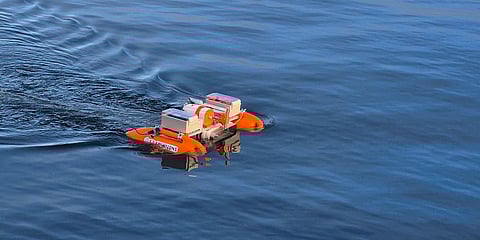


The first trial run of the USV Pamela, mounted with an eDNA sampler.
Photo: Maria Guttu/Akvaplan-niva

A Norwegian research team is investigating whether environmental DNA (eDNA) can be used to detect harmful jellyfish more quickly at salmon farming facilities.
The seasonal influx of "pearl chain" jellyfish Apolemia has in recent years caused significant fish mortalities in Norway's aquaculture industry, with a major bloom in 2023 believed to have caused the deaths of around three million farmed fish. The jellyfish, which form long string-like colonies which can float into aquaculture cages and sting fish, causing injuries and stress.
However, according to researchers, current monitoring methods can be slow and depend on specialist laboratory work. The project, led in part by Akvaplan-niva, is assessing whether DNA-based testing can be carried out closer to the field and deliver results faster.
Andrea Knutsen, a master’s student at the Norwegian University of Science and Technology, is developing and validating the detection protocols.
“Current monitoring methods are often poorly suitable for these fragile organisms. They are often also slow and highly dependent on taxonomic expertise or specialized laboratory facilities,” she said. “That makes early detection difficult, which in turn limits the ability to respond in time.”
Field trials have taken place at a salmon farm along the Trøndelag coast, where researchers collected weekly water samples both manually, directly from the farm platform, and by an uncrewed surface vessel which followed pre-set routes and filtered water for DNA analysis. The study is comparing different sample collection techniques to see which provides the most reliable data for real-time monitoring, "especially when Apolemia occurrences can be highly patchy,” Knutsen explained.
The Jellysafe research project is financed by FHF – The Norwegian Seafood Research Fund and led by the Institute of Marine Research (Havforskningsinstituttet), with several Norwegian research and industry partners involved.
