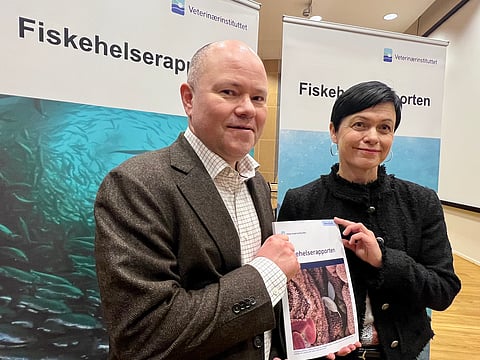


Editor of the Fish Health Report, Torfinn Möldal, and Director of the Department of Fish Health and Fish Welfare at the Norwegian Veterinary Institute, Ingunn Sommerset.
Photo: Asle Haukaas / Veterinærinstituttet

Warmer sea temperatures are reshaping disease risks in Norway’s salmon farming industry, with parasites and some infectious diseases appearing further north, according to the latest Fish Health Report published by the Norwegian Veterinary Institute (Veterinærinstituttet).
The annual report, presented in Bergen on 11 March, draws on public statistics, laboratory diagnostics, survey responses from fish health professionals and mortality data collected through the industry initiative AquaCloud, to outline the main health and welfare trends observed in Norwegian aquaculture during 2025.
Despite an increase in parasite treatments, the report indicates that overall mortality among farmed salmon fell slightly compared with the previous two years.
One of the main messages of this year's report is the impact of warmer seas on how parasites and microorganisms spread along the Norwegian coast - with these increasingly moving northwards.
“Periods of warmer seas mean that sea lice and other harmful parasites and microorganisms multiply faster and can gain a foothold in new areas. We are already seeing this in the fact that diseases that have been common in the south are now also present further north," said Ingunn Sommerset, director of the Department of Fish Health and Fish Welfare at the Norwegian Veterinary Institute.
"There is much evidence that climate change is changing the production conditions for farmed fish along the coast,” Sommerset stated.
Sea lice remain the most significant parasite challenge for the industry. Farms recorded 3,918 treatment weeks in 2025, about 700 more than the previous year. The report notes that the increase included a record level of non-medicinal treatments.
Survey responses from fish health personnel reflect this trend. In the annual survey, 81% reported a growing need for lice treatments.
The report also notes a rise in amoebic gill disease (AGD), a parasitic infection affecting salmon gills. A total of 99 cases were recorded in 2025, higher than in previous years, with the parasite responsible, Paramoeba perurans, detected as far north as Troms.
Alongside parasites, the report summarised the incidence and impact of several infectious diseases affecting farmed fish.
The bacterial disease pasteurellosis, which has mainly affected salmon farms in western Norway in recent years, was recorded further north during 2024 and 2025. Outbreaks were reported in northern Trøndelag and isolated cases were detected in the Andfjorden-Senja area.
There was also a rise in cases of infectious pancreatic necrosis (IPN). The prevalence of this virus, which attacks the pancreas and can lead to increased mortality, slower growth and poorer welfare, has been reduced in recent years through breeding programmes aimed at increasing genetic resistance, the removal of persistent infection sources and vaccination. However, the Veterinary Institute found a total of 40 cases were registered in 2025, around three times the number recorded the previous year.
Among other infectious diseases, heart and skeletal muscle inflammation (HSMB) and cardiomyopathy syndrome (CMS) were detected at more locations in 2025 than in 2024. In the industry survey, HSMB ranked as the third most significant health challenge for salmon in the grow-out phase, while CMS was ranked fifth.
Meanwhile, cases of classical winter sore caused by the bacterium Moritella viscosa declined last year, continuing a trend since 2023. The disease was detected at 246 salmon farming sites in 2025, compared with 289 sites in 2024 and 320 the year before. The institute notes that almost all salmon in the hatchery phase were vaccinated with a new winter sore vaccine during the year.
The report indicates that mortality in the sea phase declined compared with the previous two years.
A total of 54.9 million farmed salmon were reported dead during the marine grow-out stage in 2025. This compares with 57.8 million in 2024 and the crisis year of 2023, when Norway recorded its highest-ever mortality rate of sea-phase salmon, reaching 62.8 million, and prompting calls for serious action on fish health and welfare.
Calculated as annual mortality risk, the rate fell to 14.2% in 2025, compared with 15.4% in 2024 and 16.7% in 2023.
Mortality in earlier life stages showed mixed trends. The number of dead salmon fry weighing more than three grams fell to 43.3 million in 2025, down from 46.3 million in 2024. Rainbow trout fry mortality also declined, dropping to 2.84 million from 3.45 million the previous year.
By contrast, cod fry mortality increased to 2.44 million, up from 1.68 million in 2024. The report notes that the way mortality data is reported makes it difficult to calculate annual percentage mortality for the fry stage.
Sea lice remain the most significant parasite challenge for the industry.
Photo: Stine Gismervik / Veterinærinstituttet - Norwegian Veterinary Institute.
While diseases and environmental conditions were significant factors in the overall mortality figures, the report indicated that compared with the previous year, injuries appear to have played a larger role.
Data from farms that record causes of fish deaths through AquaCloud showed that injuries were the most frequently reported cause of mortality in 2025, accounting for around 33.5% of recorded deaths. Infectious diseases represented about 28%, while unknown causes made up roughly 27% and environmental conditions about 4%.
Overall, the report indicated an improvement in the quality of the salmon produced, with the proportion graded as “superior” rising from 80.6% in 2024 to 86.9% in 2025. According to the Institute, "the most common reason for downgrading salmon is wounds and injuries, and a higher proportion of superior salmon indicates better welfare."
The Veterinary Institute indicated confidence in its figures, which were drawn from a variety of datasets. “It is a great strength that data from various sources such as AquaCloud, laboratory studies and the questionnaire survey point in the same direction,” said Torfinn Möldal, editor of the Fish Health Report.
The full report can be found on the Norwegian Veterinary Institute website.
