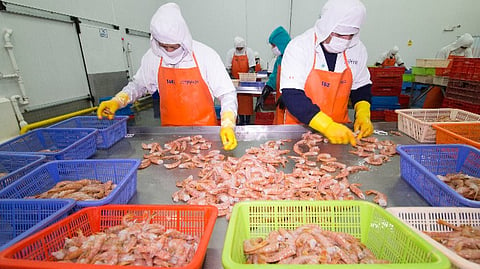


Frozen shrimp, together with fishmeal, frozen jumbo flying squid, and fresh and frozen jack mackerel, were which accounted for most of the volume and value of exports backed by these certifications.
Photo: Produce.

Peru's Ministry of Production (Produce) reported that health certifications for hydrobiological products skyrocketed in the country last year, with the Peruvian National Authority for Sanitary Certification in Fishing and Aquaculture (Sanipes) issuing a total of 32,587 health certificates during 2025.
Compared to 2024, when 23,425 certificates were issued, last year saw a 39.1% increase in the issuance of health certificates in Peru, strengthening domestic and international trade in hydrobiological products and benefiting 614 companies in the sector.
"These certificates represent the confidence that Peru places in its hydrobiological products, guaranteeing that they meet the highest health standards and promoting their positioning in international markets," emphasized Sanipes Executive President Mónica Saavedra.
Peru's Minister of Production, César Quispe Luján, expressed a similar view. "The work of Sanipes is key to ensuring that our fishery and aquaculture products meet the highest health standards, which allows us to consolidate the confidence of international markets and continue to boost exports," he said.
In order to issue these health certificates, the Peruvian National Authority for Sanitary Certification in Fishing and Aquaculture verifies compliance with national and international health regulations, ensuring the safety and health of hydrobiological resources and products, with the aim of protecting public health and contributing to trade development.
Thus, thanks to the health certificates issued by Sanipes, a total volume of 1,907,244.5 metric tons of fishery and aquaculture products was exported in 2025, with a value of USD 4,115.6 million FOB - this is 'Free On Board', which represents the cost of the goods at the point of shipment or loading, excluding insurance and freight costs.
Among the main products exported are fishmeal—in an average year, Peru accounts for around 20% of global production of both fishmeal and fish oil—frozen jumbo flying squid and frozen shrimp, as well as fresh and frozen jack mackerel, which accounted for most of the volume and value of exports backed by these certifications.
In line with certification and compliance with international health and sustainability regulations, Peru recently ensured the continuity of its mahi-mahi exports to the United States by approving a set of measures to comply with the environmental standards required by the US Marine Mammal Protection Act (MMPA) and passed a decree to amend the Marine Macroalgae Fishing Regulations in order to strengthen sustainability and improve the traceability of this resource.
However, as Produce pointed out, this growth not only supported the export, import, and marketing of hydrobiological resources and products but also the operation of production and processing plants and aquaculture sites nationwide.
As WeAreAquaculture reported, already during the first half of 2025, through Sanipes, Produce had granted a total of 1,090 health certifications to fishing and aquaculture operators in 20 regions of the country, which at that time represented an increase of 53.09% over the same period the previous year.
As mentioned above, at the end of the year, the total number of companies benefiting from the scheme was 614, which, compared to the 451 companies certified in 2024, represented an increase of 13.6% in 2025, reflecting greater dynamism in the Peruvian fisheries and aquaculture sector.
Produce provided one final piece of information, indicating that from 2015 to date, Peru's National Health Certification Authority for Fisheries and Aquaculture has issued a total of 298,466 health certificates.
