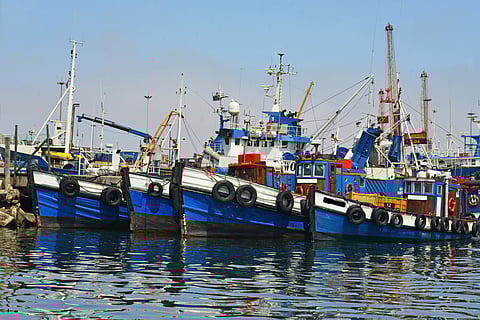


Fischereihafen von Walvis Bay , Namibia
Adobe Stock

The Namibian hake trawl and longline fishery, which targets two hake species (Merluccius capensis and M. paradoxus), has achieved its second Marine Stewardship Council (MSC) certification.
The assessment, which examined the hake stocks, the fishery's management processes, and its impacts on the ecosystem, was led by Control Union (UK) Limited.
In 2020, this fishery had already become the first in Namibia and the second in Africa to achieve this distinction.
"Achieving MSC certification, first in 2020 and now, has been a team effort and provides assurance to the world that we are committed to the sustainability of Namibian hake," expressed Chair of Namibian Hake Association, Matti Amukwa.
The strategy of the Namibian and South African hake trawl fisheries, developed with scientific advice, requires them to collaborate and share information on stock assessments.
"Since the first certification, we have gained access to several new, high-value markets and are known in Europe, and elsewhere, for our quality hake and good environmental and ethical practices," detailed Tristan Przybylski of Seawork Fish Processors.
In addition, they implement control, surveillance, and monitoring measures both at sea and on land, along with programs to assess risks to sensitive habitats.
Finally, with the support of the MSC's Ocean Stewardship Fund, targeted acoustic startle technology (TAST) developed by GenusWave is being used to repel other species.
"The fishing industry is very important to our country. Not only does it contribute roughly 7% to the Namibian GDP, but it also employs in the region of 16,000 people in direct jobs, and indirectly, you could easily use a coefficient of three. Of this, the hake industry is the biggest constituency of the Namibian fishing industry," assured Miguel Angel Tordesillas of Novanam & Nueva Pescanova.
