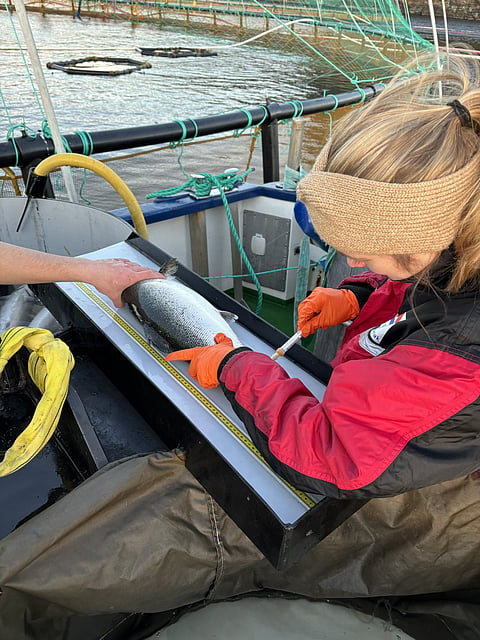


WellFish Tech's blood sampling technique has been cleared for use in salmon over 500g.
Photo: WellFish Tech

Aquaculture biotechnology firm WellFish Tech has received clearance from the Norwegian Food Safety Authority, Mattilsynet, for the use of non-lethal blood sampling in Atlantic salmon at commercial aquaculture sites in Norway, as the company also expands its work with Norwegian land-based salmon producers Bue Salmon and Andfjord Salmon.
According to the company, the decision marks the first time a non-lethal blood sampling method has met Norway’s animal welfare documentation requirements. It also removes a prohibition on the method that had been in place for several years.
The clearance follows a multi-year programme of research and documentation, including two field and laboratory trials designed to address welfare evidence requested by Mattilsynet. One trial was carried out at LetSea AS in Norway in spring 2025, testing the method in Atlantic salmon held in sea cages at 5-8°C, conditions described by WellFish Tech as "challenging" for welfare and wound healing. A parallel controlled trial at AquaBioTech Group’s facility in Malta provided data at higher water temperatures.
WellFish Tech said both trials showed the procedure could be carried out without compromising fish survival, growth or welfare, provided it was performed by trained personnel using the company’s standardised protocol.
“We are proud of the rigorous work that underpins this approval,” said Charlie Granfelt, CEO of WellFish Tech. “This has been a collaborative effort with the scientific community and regulators, with one goal: better fish health. Having a non-lethal diagnostic method formally recognised in Norway is a meaningful step for the industry.”
A representative of Mattilsynet said the authority required methods used in commercial aquaculture to be documented as defensible from an animal welfare perspective.
“We consider the submitted documentation to provide a basis for use of this method within the specified conditions,” the representative said.
The method allows fish health professionals to draw diagnostic blood samples from live salmon before returning them to the production environment. Conventional blood sampling in salmon farming has generally required fish to be euthanised, however WellFish Tech’s approach involves sampling from the caudal vein under anaesthesia, giving access to biochemical biomarkers intended to provide a real-time picture of fish physiological status.
The Norwegian clearance applies to Atlantic salmon above 500g, with sampling limited to a maximum volume of 1 mL per fish, with at least 14 days required between repeated samples from the same individual. The method must also be carried out under the professional responsibility of authorised fish health personnel, WellFish said. The company completed the required revision of its standard operating procedure on 4 May 2026, and said the updated protocol will govern all non-lethal blood sampling activity carried out under its service.
Heidi Johansen Nedberg, fish health specialist at Bue Salmon, with Randi Fivelstad, technical lead for WellFish Tech.
Photo: WellFish Tech
The Norwegian authority's decision comes as the Paisley-headquartered company strengthens its position in Norway through new and renewed partnerships with land-based salmon producers.
At the end of May, WellFish Tech announced it had renewed its partnership with Bue Salmon, which has used the company’s routine blood biomarker analysis at its pilot facility at Gjørøy Nord in Bulandet since September 2025. Bue said the service is being used to generate biological data to support production decisions before challenges arise, and to identify which operational strategies are producing results.
“For us, it is about using data to make better decisions,” said Heidi Johansen Nedberg, Fish Health and Quality Consultant at Bue Salmon. “The continuous analyses give us an earlier and clearer picture of how the fish are doing, and that enables us to work proactively rather than reactively.”
The renewed agreement comes as Bue continues development work at Lutelandet in Vestland, where it holds a 50,000-tonne licence and has begun preparatory groundworks for what it aims to develop into Norway’s largest land-based salmon farming facility. Bue currently operates a pilot facility in Bulandet with annual production capacity of just under 2,000 tonnes, while its long-term target at Lutelandet is around 50,000-60,000 tonnes of salmon a year.
“When you are scaling a production model that has never been done at this size before, you cannot afford to be reactive,” said Knut Eikeland, CEO of Bue Salmon. “Blood biomarker analysis gives us the biological data we need to make the right calls before problems arise, and to understand which parts of our operation are actually performing. That kind of insight is going to be critical as we move into Lutelandet.”
On 1 June, WellFish Tech also announced a commercial partnership with Andfjord Salmon, the Oslo-listed land-based salmon farmer operating a land-based flow-through system at Kvalnes on Andøya in northern Norway.
Under that agreement, WellFish Tech will deploy its WellFish Predict monitoring programme across active cohorts at Andfjord’s Kvalnes production site. The programme will provide blood biomarker analysis, predictive mortality modelling and gill health prediction, with the aim of giving Andfjord’s team biological data to use alongside existing environmental and operational monitoring.
According to WellFish Tech, the use of predictive models covering mortality risk at 14 and 28 days, and gill health up to six weeks before visible pathology, is particularly relevant in RAS and flow-through environments where early biological signals can have significant operational value.
“We have always believed that good outcomes for fish health are inseparable from good outcomes for the business,” said Martin Rasmussen, CEO of Andfjord Salmon. “Our survival and growth data demonstrates what is possible when you give salmon the right environment - but we want to go further. Blood biochemistry gives us a direct window into the physiological state of our fish that no environmental sensor or behavioural observation can provide. We want the decisions we make at Kvalnes to be grounded in the most precise and robust data available, and this partnership gives us that.”
Granfelt said Andfjord had built “something genuinely exceptional” at Kvalnes.
“They are asking exactly the right question - not just how do we maintain these results, but how do we understand them well enough to be certain we can sustain them at scale,” he said. “We are looking forward to working with Martin and the team as they build out one of the most ambitious land-based salmon operations in the world.”
WellFish Tech said the developments reflect growing interest in fish-level biochemical data as producers seek earlier indicators of health, welfare and performance.
The company currently employs 26 people and operates in the UK and Ireland, Norway and Canada, while also supporting customers outside those markets.
