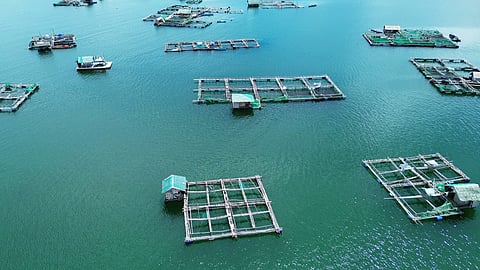


Fish farm with cages for fish and shrimp.
Adobe Stock

The Department of Agriculture – Bureau of Fisheries and Aquatic Resources in the Philippines has outlined its 2026 plans, which include strengthening fisheries management, accelerating aquaculture development, and enhancing enforcement and research capabilities.
Among its priorities is the implementation and further development of the Fisheries Management Area (FMA) framework, which it considers essential for science-based and environmentally responsible fisheries governance.
Programs will focus on modernizing hatcheries, improving the quality of broodstock and seed, and expanding feeding and production technologies to support a stable and affordable supply of fish.
In this way, the government aims to respond to the ecological limits of capture fisheries while also creating resilient livelihood options for coastal and inland communities.
For example, the Marawi Fisheries and Aquaculture Project, with an allocated budget of 500 million Philippine pesos (approximately $8.5 million), aims to help displaced communities rebuild their livelihoods through aquaculture-based employment opportunities and the sustainable development of inland fisheries.
In addition, investments will be made in integrated aquaculture and fisheries complexes, fishing ports, and post-harvest facilities to reduce post-harvest losses, improve value addition, and strengthen supply chains from production to market.
Lastly, the presence of the regional office of the Bureau of Fisheries and Aquatic Resources (BFAR), responsible for managing and overseeing fisheries and aquaculture activities in the Negros Island Region of the Philippines, will be strengthened.
A few days ago, the Government of Japan, in collaboration with the Food and Agriculture Organization of the United Nations (FAO), launched a two-year project to develop a sustainable fishery value chain in the Bangsamoro Autonomous Region in Muslim Mindanao (BARMM).
