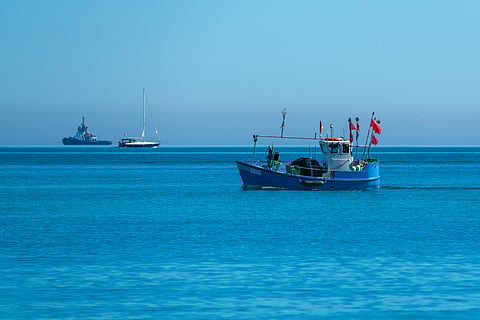


Fishing boat on the Baltic Sea.
Photo: Ina Hensel / Adobe Stock.

The European Parliament has called for emergency measures to halt the decline of fish stocks in the Baltic Sea, including a possible revision of the region’s multiannual management plan and a halt to trawling for fish meal and fish oil during a rebuilding phase.
In a report adopted by a significant majority last week (337 votes to 178, with 44 abstentions), MEPs said that, given the slow recovery of Baltic stocks, total allowable catches (TACs) should be fully aligned with the "precautionary principle". They also urged the Commission and EU countries to examine how quotas are distributed and whether this affects sustainability.
The Parliament said the Baltic Sea management plan has failed to deliver its ecological and socio-economic objectives. It called on the Commission to assess the plan and, if necessary, propose changes, while making better use of existing legal and management tools and improving coordination between policies.
The report says the Baltic Sea ecosystem needs a “reset” and calls for EU and national measures to recover and rebuild stocks. These could include suspending targeted fisheries for some species. MEPs said such action should take account of environmental and socio-economic factors, including the position of small-scale fishers.
“After years of irresponsible management and political failure, the European Parliament is finally sending a clear message to the European Commission and EU governments: business as usual is over. The Baltic Sea cannot survive more empty promises and delayed action," said rapporteur Isabella Lövin, a Swedish Green MEP.
"It is time to rebuild our sea. Millions of citizens across the eight EU member states surrounding the Baltic expect politicians to take responsibility — and with this report, Parliament is finally delivering on that expectation,” Lövin added.
MEPs also called for stronger scientific evidence to underpin fisheries decisions. Parliament wants comprehensive genetic population mapping in the Baltic Sea for commercially exploited species such as herring and sprat, and said EU countries and the Commission should provide updated fishing data to the International Council for the Exploration of the Sea (ICES).
The report also asks the Commission to seek ICES advice on "precautionary buffers related to the uncertainty of the scientific advice”, and to consider this when setting rebuilding measures for Baltic stocks, and for advice on the effects of not using population ranges above maximum sustainable yield levels.
The report also criticised Russia’s fishing activity in the region, condemning what MEPs described as “Russia’s irresponsible, unsustainable and unscientific exploitation of Baltic Sea fish stocks” through unilateral quota-setting.
Parliament called on the Commission and Baltic EU countries to propose halting trawling for fish meal and fish oil during a rebuilding phase, while also limiting extractive activities in marine protected areas.
During a plenary debate prior to the vote, Fisheries and Oceans Commissioner Costas Kadis said the Commission welcomed the report and the shared concerns about the condition of the Baltic.
“The situation of the Baltic Sea ecosystem has been difficult for far too long,” Kadis said. “The report rightly underscores the necessity for comprehensive action and cooperation with all the relevant actors across multiple policies concerned.”
He said many of the factors impacting the Baltic go beyond fisheries and cannot be addressed by the Common Fisheries Policy alone. These include nutrient inflows, eutrophication, pollutants, unexploded munitions, and climate change, as well as offshore wind development and marine protected areas.
“A more comprehensive approach with coordinated cross-border action across all relevant sectors and policy fields is needed. This is precisely why the European Ocean Pact is so critical to bring science, policy, and practice together to build a comprehensive strategy that delivers real results,” Kadis said, adding that the European Commission would “carefully look into all options” regarding Parliament’s call to evaluate and possibly revise the Baltic Sea multiannual plan.
Kadis said the European Commission was already working with scientists and member states to identify stocks that could benefit from multiannual advice. He added that the Commission is in "close dialogue" with the International Council for the Exploration of the Sea on the creation of a new research programme focused on formulating ecosystem-based scientific advice for the western Baltic fisheries.
"The aim is to develop the scientific and operational foundation needed to produce actionable advice that takes into account a wide range of ecosystem issues," he said.
