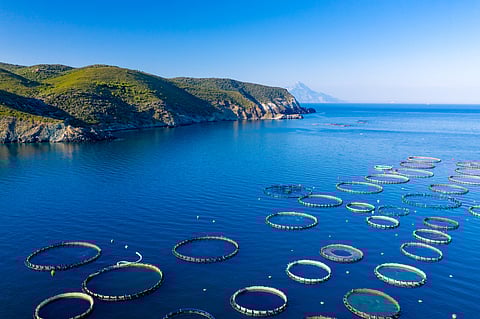


A sea bream aquaculture farm in Greece.
Photo: Adobe Stock.

The Federation of European Aquaculture Producers (FEAP) warns that European aquaculture is at a "critical" juncture and urges the EU to address the root causes of the sector's decline.
In its official response to the European Commission's Vision 2040 for Fisheries and Aquaculture, FEAP also supports the initiative as a way to redirect the policies and guidelines that have guided the sector to date.
"After 25 years of stagnation, Vision 2040 is the last real opportunity to build a competitive, sustainable, and strategically relevant sector," said Javier Ojeda, Secretary General of FEAP.
FEAP warns that the current situation is due to an "inadequate and overly burdensome" EU legal framework, particularly in the environmental domain. This fundamentally limits effective governance at national and regional levels and restricts access to new farming sites.
For this reason, the organization calls for independent and thorough reviews in Member States to examine both successful and failed aquaculture initiatives.
"What we need at the European level is restraint: new regulation should be limited to what is strictly necessary, especially given today’s geostrategic realities," Ojeda specified.
Additionally, FEAP once again highlights the need to establish a Common EU Aquaculture Policy to distinguish it from fisheries and agriculture, thereby enhancing the value of freshwater aquaculture and ensuring it is included in the Ocean Pact.
In 2025, FEAP already warned that the "critical omission" of freshwater aquaculture in the European Ocean Pact highlights a "fundamental mismatch" between the sector and its position in the EU legal framework.
Finally, it calls for Vision 2040 to include a structural funding program under the next Multiannual Financial Framework, building on the current European Maritime, Fisheries and Aquaculture Fund (EMFAF) for the 2028–2034 programming period.
"Vision 2040 must set a clear fish production target, ensure policy coherence across EU initiatives—including broader frameworks such as Food 2030 and the EU food systems transition—and commit to a market-driven approach supported by stable funding," Ojeda concluded.
