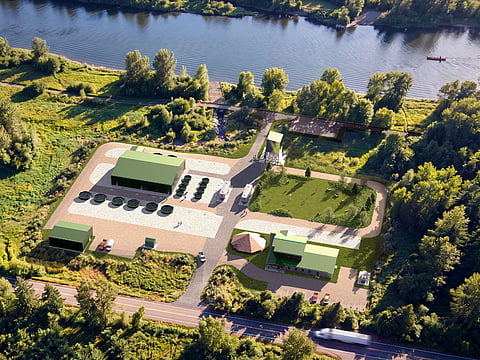


Architectural rendering of the Upper Fraser River Conservation Hatchery.
Photo: Fisheries and Oceans Canada

The Canadian government has advanced three new salmon hatchery projects in British Columbia, awarding construction contracts worth more than CAD 53 million (EUR 32.8m/USD 38.2m) as part of efforts to rebuild vulnerable Pacific salmon populations.
Fisheries and Oceans Canada (DFO) announced the three developments on 25 August, covering two hatcheries focused on Chinook salmon in the Fraser River watershed and a third for sockeye salmon in the Skeena River system.
All three projects are being developed in partnership with First Nations.
The largest contract, worth more than CAD 38 million (EUR 23.5m/USD 27.4m), has been awarded to IDL Projects Inc. for construction of the Upper Fraser River Salmon Conservation Hatchery in Prince George.
The facility will be built on the north bank of the Nechako River, close to its confluence with the Fraser River and within Lheidli T’enneh First Nation territory. DFO will own and operate the hatchery, which will be collaboratively managed with Lheidli T’enneh First Nation, with support from forestry company Canfor.
It is designed with an initial capacity of 400,000 juvenile Chinook salmon annually. DFO said the facility could later expand its Chinook production or be adapted to support other species including sockeye.
“As a Nation, fisheries are central to the work we do. We remain committed to maintaining biodiversity in our traditional territory while enhancing salmon populations throughout the region,” said Lheidli T’enneh Chief Dolleen Logan. “With an eye towards our shared future, we are positioned to impart traditional knowledge and opportunities on Nation youth, while developing new skills and employment opportunities.”
A second contract, valued at more than CAD 7.5 million (EUR 4.6m/USD 5.4m), has been awarded to Industra Construction for a new conservation hatchery near Hanceville in the upper Fraser River watershed.
DFO and the Tŝilhqot’in National Government have worked on feasibility studies, design and permitting for the facility since 2022. The Canadian government will build the hatchery, while the Tŝilhqot’in National Government will operate it.
Its initial capacity will be 250,000 Chinook fry per year, targeting populations in the Chilcotin River watershed and surrounding area. DFO said a number of those populations have been assessed as at risk by the Committee on the Status of Endangered Wildlife in Canada. Groundbreaking is planned for autumn 2026.
“Salmon are not just a resource for our people; they are food security, intergenerational knowledge sharing, connection to the land and waters, our culture, and who we are as Tŝilhqot'in, the River People,” said Chief Otis Guichon, Sr., Tŝideldel First Nation and Tribal Chief of the Tŝilhqot’in National Government.
“We’ve been working toward this permanent hatchery since 2019 because we know that our fish should be raised here at home,” he added.
The third project is the Wilp’Ho Dix Hatchery on the Kitwanga River, a tributary of the Skeena River in northwestern British Columbia.
Progressive Ventures Construction has been awarded a contract worth more than CAD 7.5 million (EUR 4.6m/USD 5.4m) for the next phase of the project. The facility will be built by the federal government and operated in partnership with Gitanyow First Nation.
The hatchery is intended to produce Kitwanga River sockeye, which DFO describes as a stock of significant conservation concern and one of cultural importance to Gitanyow Nation. Its initial capacity will be 300,000 juveniles, with scope to increase this to 400,000.
“Thirty years ago, Chief Biiyosxw of Wilp Gwaas Hla’am was raising salmon in a small wooden shed beside the creek because we understood then, as we do today, that we have a responsibility to care for the salmon and the waters that sustain them,” said Joel Starlund/Sk’a’nism Tsa ‘Win’Giit, Executive Director of the Gitanyow Hereditary Chiefs Office. “To see Wilp’Ho Dix now taking shape at the entrance to Gitanyow Village is incredibly meaningful.”
All three hatcheries are being financed through one-off capital investments for construction and equipment under the first phase of Canada’s Pacific Salmon Strategy Initiative, covering 2021-2025. The federal government announced a further CAD 412.9 million (EUR 255.3m/USD 297.5m) for the initiative over the following five years in March 2026, although allocations from the new funding have yet to be announced.
DFO’s Salmonid Enhancement Program currently produces more than 300 million juvenile salmon each year in British Columbia for conservation, stock assessment and harvest purposes.
