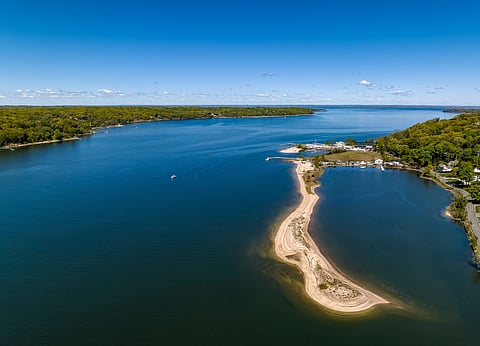


Aerial view of Oyster Bay, Long Island.
Photo: Adobe Stock

Oyster aquaculture may be playing an unexpected role in the recovery of depleted wild stocks in New York, according to new research from Cornell University, supported by New York Sea Grant.
Genetic analysis carried out by the university found signs of interbreeding between farmed and wild eastern oysters in the East River and parts of Long Island Sound. The researchers said the findings provide the first direct evidence that oysters originating from farms are contributing to naturally occurring populations in the region.
Matthew Hare, associate professor at Cornell University and senior author of the study, said reproductive activity at farms could increase the number of oysters settling in surrounding waters.
“Oyster farms might provide ecosystem services to the natural system, with one of those being a boost to oyster populations that are dwindling,” Hare said.
“If a farm is near an oyster population and there’s any reproduction on the farm, it’s possible that it can provide a demographic supplement and basically build up populations nearby, because the offspring from the farm could end up in the wild population,” he added.
The research team compared oyster genomes from several locations, including the Hudson River, East River and Connecticut waters in Long Island Sound. The analysis drew on domestication markers previously identified by Hare to distinguish aquaculture ancestry from that of wild stocks.
Clear differences emerged between the sampling areas. Oysters collected from the Hudson River showed little evidence of genetic input from aquaculture. This was consistent, researchers said, with the limited presence of oyster farming in the area, where much of the water is closed to shellfish production because of pollution and food-safety concerns.
However, the team found that samples from the East River and Connecticut contained a combination of wild and farm-derived genetic traits.
“Whereas in the East River and in Connecticut, we saw oysters had this kind of mixed pattern, the mixture being the wild and also the farmed aquaculture ancestry,” Hare said.
However, the researchers warned that the ecological and genetic implications of continued mixing are not yet fully understood. While introducing farmed genes could alter the makeup of wild populations, selected traits such as greater resistance to disease may also improve their ability to survive.
Wild oyster reefs were once widespread across New York’s estuaries and rivers, covering an estimated 220,000 acres during the 17th century. Their extent later collapsed as a result of intensive harvesting, pollution and sediment accumulation.
Commercial production in the state is now dominated by aquaculture. In 2023, farm-raised oysters accounted for 84% of New York’s eastern oyster harvest.
As previously reported by WeAreAquacuture, oyster farmers in the state recently faced a major setback, after severe winter weather caused heavy losses for Long Island producers, with estimated production losses of more than 30% and repair costs of almost $2.4 million. The United States Department of Agriculture issued a disaster declaration enabling eligible farm operators in Suffolk County and neighbouring Nassau County to apply for disaster assistance and low-interest emergency loans.
New York officials have described the shellfish aquaculture sector as an important part of the state’s agricultural and coastal economy, made up largely of small and family-owned businesses.
