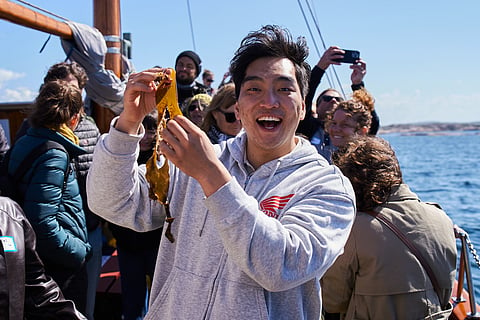


A conference participant pictured on this year's site visit to Nordic SeaFarm's seaweed cultivation site in the Grebbestad archipelago.
Photo: Seagriculture

Last week's Seagriculture EU 2026 conference brought together 229 participants from 28 countries in Gothenburg, Sweden, as the European seaweed sector continues to assess how it can move "from promise to practice".
Held from 16-18 June under the theme “The European seaweed industry in transition: survival, scale and real impact,” the conference focused on the commercial, regulatory and technical hurdles facing seaweed producers, researchers, investors and technology providers.
The event covered a wide range of topics, including legislation, food systems, selective breeding, biostimulants, biomaterials, financing models, biodiversity, carbon capture and industrial scaling. Organisers DLG Benelux said this year's discussions reflected both the progress made by the sector in recent years, and the realities of building resilient and commercially viable seaweed businesses in a changing market environment.
The conference opened with welcome addresses from Prof. Katharina Riehn, Vice President at DLG; Margareta Broang, Deputy Lord Mayor of the City of Gothenburg; Renée Bengtsson, President of Region Västra Götaland; and Christer Olausson, CEO of Nordic SeaFarm, the company which also hosted this year's site visit, and who told WeAreAquaculture in a recent interview that "building a seaweed industry takes time," but that now "the foundation is finally in place to start scaling in a more focused and realistic way."
One of the main keynote presentations was delivered by Robert Carleke, Innovation Ventures Manager at Inter IKEA Group, who outlined how IKEA is exploring seaweed-based materials and their potential applications “from ocean to home.”
Other keynote sessions examined financing for the European seaweed industry, the need to professionalise the sector, and the role of seaweed in climate mitigation and blue carbon initiatives.
A session titled “Epic fails and honest tales: Mistakes that made us” was among the most notable parts of the programme, with speakers sharing lessons from setbacks encountered while developing seaweed businesses and research projects.
Panel discussion on financial needs for the maturing European seaweed industry, featuring from left: Ola Jönsson (Partners in Quest), Alex Shapiro (WWF), Michael White (Planet Ocean Capital), Marie Sandin (Tetra Pak), Adam Kybird (Pymwymic Healthy Food Systems Growth Fund).
Photo: Seagriculture
The conference also saw the return of the Seaweed Elevator Pitches, where researchers, startups and industry professionals presented projects and business ideas in five-minute presentations. Topics included food safety, processing technologies, biodiversity solutions, blue biorefinery development and other areas linked to the future commercialisation of seaweed.
Alongside the conference programme, the event also featured a trade show with a record 19 exhibitors presenting cultivation systems, processing solutions, technologies and services for the industry.
More than 50 poster presentations were also displayed, marking the largest poster contribution in the history of Seagriculture EU.
Participants onboard for the site visit to Nordic SeaFarm.
Photo: Seagriculture
Participants also joined a full-day site visit hosted by Nordic SeaFarm, which included a boat trip to the company’s seaweed farming site in the Grebbestad archipelago, as well as a tour of the Tjärnö Marine Laboratory.
Nordic SeaFarm was founded at the laboratory, where researchers from the University of Gothenburg’s Department of Marine Sciences shared insights into ongoing seaweed research.
“This year’s conference showed that the European seaweed industry is continuing to grow and mature,” said Kuno Jacobs, Managing Director at DLG Markets Benelux, organiser of Seagriculture EU 2026.
“It was great to see so many stakeholders openly sharing experiences, discussing challenges, and exploring opportunities for collaboration and growth.”
Networking was also a central part of the event, including a conference dinner at Gothenburg’s Feskekörka, the historic “Fish Church.”
Seagriculture EU 2027 is scheduled to take place in Ostend, Belgium, from 15-17 June 2027.
WeAreAquaculture is a media partner of Seagriculture, and once again reported live direct from the conference via a liveblog covering the main speakers and issues discussed.
Read the full liveblog transcript:
