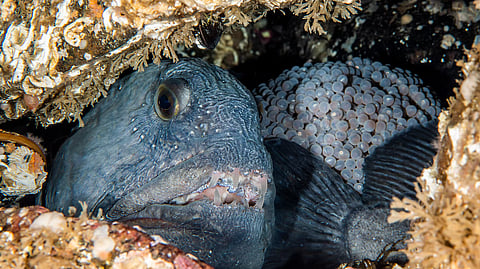


A wild male Atlantic wolffish guarding an egg mass.
Photo: Erling Svensen

Akvaplan-niva, the non-profit research and consulting subsidiary of the Norwegian Institute for Water Research (NIVA), is leading the BlueRewilding project, which aims to strengthen predator populations and promote the long-term restoration of kelp forests along the coast of northern Norway.
According to Akvaplan-niva, maintaining populations of sea urchin predators—such as fish, crabs, lobsters and Atlantic wolffish—has proven to be "essential" for the long-term recovery of kelp forests.
For this reason, in June 2025, 30 wild Atlantic wolffish were collected to serve as broodstock at Akvaplan-niva's research station on the outskirts of Tromsø.
Several months later, the first female spawned, followed by the remaining females over the following weeks. The fertilised eggs are currently being incubated and are expected to hatch soon.
Funded by Restorae and Trefadder/Vår Energi, the BlueRewilding project includes larval first feeding, monitoring juvenile growth, and adapting young Atlantic wolffish to feeding on sea urchins as prey. The goal is to produce 500 release-ready fish for field trials.
Furthermore, the project will collect genetic samples from wild Atlantic wolffish populations in four to five fjords and coastal areas near Tromsø. These data will support future population management and conservation efforts.
Finally, applications for permits to release the fish will be submitted, along with studies to determine the best size, age, and release frequency needed to carry out large-scale restoration.
Last year, an international partnership was formed between SeaForester Group, Kongsberg Satellite Services (KSAT), and Kongsberg Discovery to support the recovery of Europe’s declining kelp forests.
